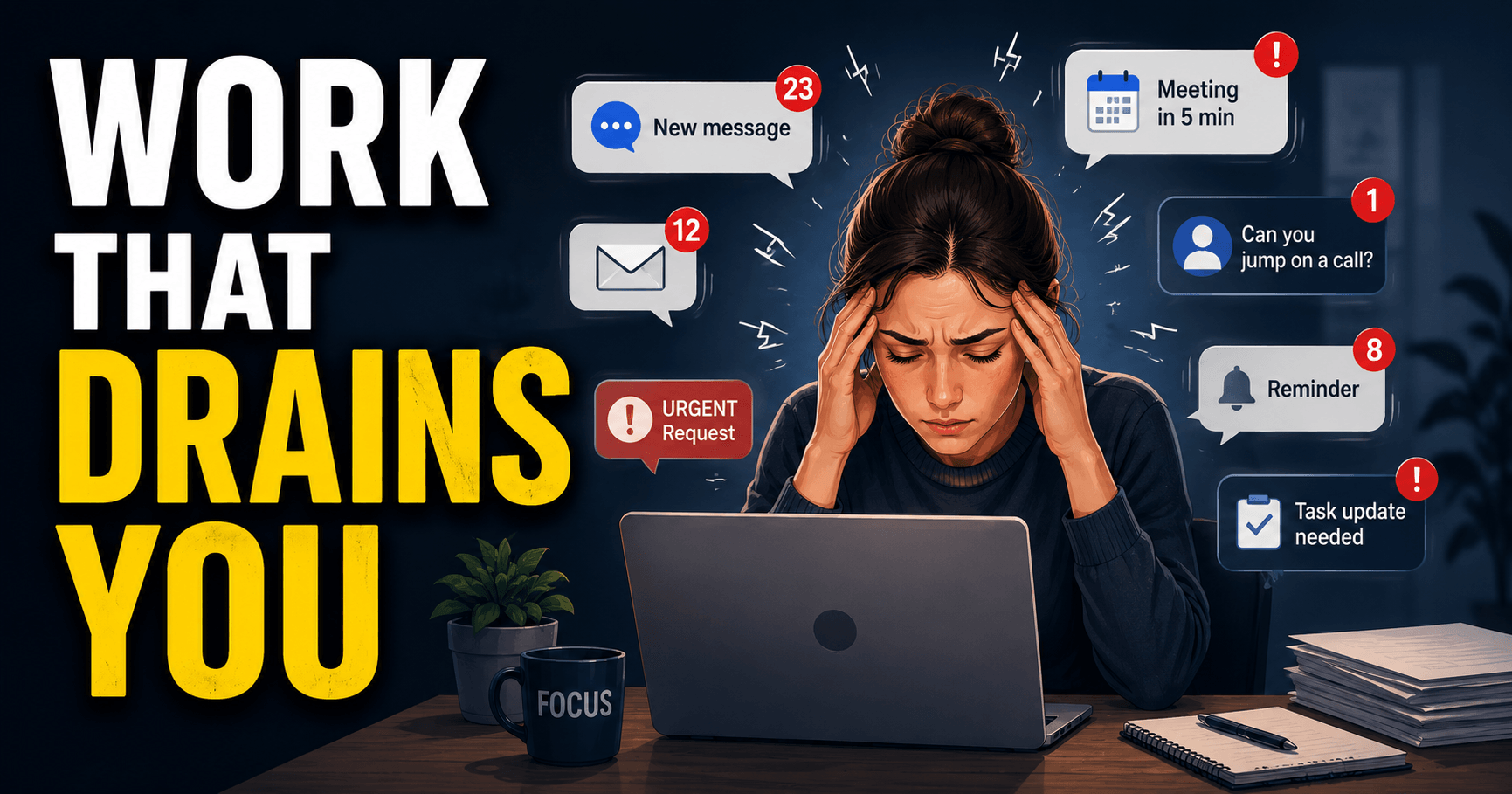
Some jobs are exhausting in ways that are difficult to explain.
You may not hate the actual work.
You may hate what surrounds the work:
- nonstop Slack messages
- constant interruptions
- back-to-back meetings
- urgent requests
- pressure to always stay available
- feeling mentally “on” all day
Many introverts assume this means they chose the wrong career.
Learning how to tell if a job will drain you as an introvert is often less about the job title itself and more about understanding the workflow, communication style, and attention demands surrounding the work.
Often, the real problem is that the workflow, communication style, and attention demands quietly conflict with how they naturally focus and recover.
That matters because most job descriptions tell you:
- the tasks
- the responsibilities
- the benefits
But they rarely tell you what your attention will actually be forced to do all day.
And that is usually what determines whether a job feels sustainable or draining long term.
Why Good Jobs Still Burn Introverts Out
One of the biggest career mistakes people make is evaluating jobs mostly by:
- title
- salary
- industry
- prestige
- remote flexibility
Those things matter.
But they do not always predict daily mental experience.
Two people can have the exact same title and completely different workdays.
One marketing role may involve:
- quiet strategy work
- writing campaigns
- focused project time
- independent planning
Another marketing role may involve:
- nonstop client revisions
- urgent Slack messages
- daily status meetings
- constant multitasking
- pressure to respond immediately
Same field.
Very different energy cost.

This is why some jobs feel exhausting even when the work itself is manageable.
The problem is often not the difficulty of the work.
The problem is the constant fragmentation around the work.
Your attention never fully settles because every focused task gets interrupted by:
- a message
- a meeting
- a “quick question”
- a shifting priority
- another notification
Over time, even simple work starts feeling mentally exhausting.
That is not weakness.
It is usually workplace mismatch.
Stop Guessing Which Job Fits You
Take the free 2-minute quiz and get personalized career recommendations.
The Hidden Parts of Jobs Nobody Talks About
Most jobs advertise:
- responsibilities
- skills
- growth opportunities
- company culture
But they rarely explain the invisible demands that shape your day.
For example:
- How often will you be interrupted?
- How many meetings are normal?
- Are replies expected immediately?
- Will you constantly switch tasks?
- Is the workflow calm or reactive?
- Will you handle emotional conflict all day?
- Do people actually get uninterrupted focus time?
These details often determine whether a role feels manageable after six months or exhausting after three weeks.
A role can sound calm in a job description and feel chaotic in reality.
For example:
- A remote support role may sound flexible until you realize your day is nonstop live chats and rapid-response tickets.
- A content marketing role may sound creative until every project becomes urgent revisions and same-day client feedback.
- A project coordinator role may sound organized until your calendar fills with status meetings, follow-ups, and shifting priorities all day long.
The actual tasks may be fine.
The operational style surrounding the work is what drains people.
A company may describe itself as:
“Fast-paced and collaborative.”
That might mean:
- healthy teamwork
- good communication
- energized momentum
Or it might mean:
- constant interruptions
- nonstop urgency
- scattered priorities
- very little focus time
- a culture where everyone is expected to stay mentally available all day
You need to learn how to recognize the difference before accepting the role.
The Translation Layer Most People Never Learn

Job descriptions often use polished language.
Your job is to translate that language into daily reality.
| Job Description Says | What It May Mean Day to Day |
|---|---|
| “Fast-paced environment” | Frequent urgency and constant context switching |
| “Strong communication skills” | Heavy meeting, messaging, or call load |
| “Collaborative culture” | Frequent interruptions and group input |
| “High-energy team” | Continuous social engagement |
| “Wears many hats” | Unclear priorities and mental fragmentation |
| “Thrives under pressure” | Reactive workflows and shifting priorities |
| “Customer-focused role” | Emotional labor throughout the day |
| “Must be highly responsive” | Little space to disconnect mentally |
None of these are automatically bad.
Some people genuinely enjoy reactive, high-energy environments.
Others tolerate them well because:
- the pay is strong
- the flexibility is worth it
- the growth opportunities are valuable
- the stress feels temporary
But if urgency, interruptions, and nonstop communication repeatedly drain you, these phrases deserve attention.
The goal is not to avoid every difficult environment.
The goal is to stop repeatedly choosing workflows built around constant fragmentation if those patterns consistently exhaust you.
Hidden Red Flags Introverts Often Ignore During Interviews
People usually focus on:
- salary
- title
- benefits
- remote work
- company reputation
Meanwhile, the real warning signs are often happening directly in front of them during the interview.
Watch for things like:
- interviewers constantly interrupting each other
- nobody clearly explaining priorities
- every answer including “fast-paced”
- employees joking about burnout or chaos
- excessive emphasis on multitasking
- vague role expectations despite many responsibilities
- extreme response-time expectations
- calendars that sound overloaded with meetings
These patterns matter.
A company’s communication style during interviews often reflects its communication culture internally.
7 Signs a Job Will Quietly Drain You

A draining job is not always obvious right away.
Some jobs actually feel exciting at first because urgency creates stimulation and momentum.
The exhaustion often appears later, once constant responsiveness becomes your normal baseline.
1. You Never Fully Mentally Clock Out
Some jobs train your brain to stay alert all the time.
You close your laptop, but part of you still expects another message.
You keep checking:
- Slack
- Teams
- notifications
Even late at night, your brain feels partially available.
This often happens in workplaces where:
- managers message after hours
- replies are expected quickly
- priorities constantly shift
- responsiveness is rewarded
That low-level tension builds slowly.
2. Your Day Revolves Around Constant Responsiveness
Some workplaces reward fast reactions more than thoughtful work.
Your day becomes:
- answering pings
- reacting to requests
- joining “quick” calls
- shifting priorities constantly
- solving urgent problems
You may feel busy all day but still feel like nothing meaningful moved forward.
This is common in:
- operations-heavy environments
- live customer support
- chaotic startups
- heavily client-facing teams
If you naturally work best through focused momentum, this kind of workflow can become exhausting surprisingly fast.
3. You Feel Mentally Tired Even When the Work Is Not That Hard
This is one of the clearest signs of mismatch.
The workload may be manageable.
The tasks themselves may even feel easy.
But by lunch, you already feel mentally drained.
That often happens when:
- your attention gets interrupted constantly
- meetings split the day into tiny chunks
- priorities change every hour
- communication never fully stops
You are not exhausted because the work is impossible.
You are exhausted because your attention never gets to settle into deep focus.
Stop Guessing Which Job Fits You
Take the free 2-minute quiz and get personalized career recommendations.
4. The Culture Rewards Visibility More Than Thoughtful Work
Some workplaces reward the people who:
- reply fastest
- talk most in meetings
- stay visibly active online
- constantly “jump in”
That can quietly punish people who prefer to:
- think before responding
- work deeply
- contribute thoughtfully
- focus without constant performance
For example:
- one employee may spend two focused hours solving a difficult problem
- another may spend those same two hours talking constantly in Slack
In some environments, the second person appears more productive simply because they are more visible.
That can slowly turn the workday into performance instead of meaningful work.
5. There Is No Real Focus Time
A company may claim it values productivity.
But the calendar usually tells the truth.
You may start the day planning to focus on important work.
Then the day disappears into:
- status meetings
- quick check-ins
- follow-up messages
- urgent requests
- constant collaboration
This is common in workflows where interruptions are normalized.
A fragmented calendar often creates mental exhaustion long before the actual workload becomes difficult.
6. Emotional Labor Is Constant
Emotional labor is one of the most overlooked forms of workplace exhaustion.
This includes:
- calming frustrated customers
- sounding upbeat all day
- absorbing other people’s stress
- handling conflict
- masking frustration constantly
This is not limited to obvious customer-service roles.
It often appears in:
- recruiting
- healthcare
- teaching
- account management
- customer success
- sales
Some introverts genuinely enjoy helping people.
But there is a major difference between:
- meaningful interaction
and - nonstop emotional performance
A one-hour conversation may feel energizing.
Eight straight hours of emotional management usually does not.
7. You Like the Work, But Not the Workflow Around It
This is the most important sign.
You may genuinely enjoy:
- writing
- solving problems
- designing systems
- helping customers
- analyzing data
- creative work
But the workflow surrounding the work makes it difficult to function consistently.
For example:
- A designer may love design but hate endless last-minute revisions.
- A writer may enjoy writing but struggle in a noisy, interruption-heavy office.
- A customer success employee may enjoy helping customers but feel drained by nonstop calls and Slack messages.
- A project manager may enjoy organizing work but burn out from constant meetings and shifting priorities.
That does not always mean you chose the wrong career.
Sometimes you chose the wrong operational environment inside the right career.
Stop Guessing Which Job Fits You
Take the free 2-minute quiz and get personalized career recommendations.
How to Decode a Job Before You Accept It
Most people evaluate jobs based on:
- salary
- benefits
- title
- company reputation
Those things matter.
But they do not tell you what daily life inside the role actually feels like.
To protect your energy long term, you need to evaluate:
- communication culture
- workflow structure
- responsiveness expectations
- interruption frequency
- meeting load
- operational rhythm
Read Job Descriptions for Hidden Signals
One phrase alone may mean nothing.
Patterns matter more.
If a job description repeatedly emphasizes:
- urgency
- multitasking
- fast communication
- high energy
- pressure
- responsiveness
- constant collaboration
that often signals a more reactive environment.
For example:
- “Strong multitasker” may mean fragmented attention all day.
- “Thrives in fast-changing environments” may mean priorities shift constantly.
- “Highly collaborative” sometimes means nonstop interruptions instead of structured teamwork.
That does not automatically make the role bad.
But it tells you how your attention will probably be used every day.
Ask Questions That Reveal Daily Reality
During interviews, ask questions like:
- “How much uninterrupted focus time do people usually get?”
- “How many meetings are typical each week?”
- “Is the workflow more project-based or reactive?”
- “How quickly are employees expected to respond?”
- “How often do priorities shift during the week?”
- “What usually creates stress in this role?”
- “How much independent work versus live collaboration happens daily?”
The answers matter.
But so does how they answer.
If the interviewer gives vague responses like:
“Everyone just jumps in wherever needed.”
that may signal:
- unclear boundaries
- reactive workflows
- operational chaos
If they clearly explain:
- workflows
- communication expectations
- focus time
- priorities
- meeting structure
that is usually a healthier sign.
Look for Patterns in Employee Reviews
Employee reviews are imperfect.
But repeated patterns matter.
Watch for repeated comments about:
- burnout
- too many meetings
- constant urgency
- unclear priorities
- micromanagement
- nonstop communication
- lack of focus time
One bad review means very little.
Repeated complaints usually reveal something real about the operational culture.
Compare the Workflow, Not Just the Job Title
A job title tells you what the role is called.
The workflow tells you how your attention will actually be used.

This comparison is more useful than asking:
“Is this a good job for introverts?”
A better question is:
“Will this role protect or constantly fracture my attention every day?”
How to Recognize a Work Environment That Will Probably Drain You Less
Not every introvert wants the same thing.
Some enjoy teamwork.
Some like customer-facing work.
Some prefer independent work.
The pattern is usually not:
“less interaction.”
The pattern is:
healthier attention management and lower cognitive fragmentation.
Many introverts tend to function better long term in environments with:
- predictable workflows
- protected focus time
- async communication
- fewer unnecessary meetings
- clearer priorities
- lower interruption frequency
- calmer collaboration styles
A sustainable job is not always easy.
It is simply a job where the hard part is the work itself, not surviving the workflow around the work.
Deep Work vs. Reactive Work
This is one of the most important career distinctions many people never learn.

Deep Work Environments
Deep work environments allow you to:
- focus for long periods
- think before responding
- solve problems deeply
- build uninterrupted momentum
These environments often appear in:
- writing
- coding
- research
- editing
- analysis
- design
If you enjoy this kind of work, you may also relate to articles about:
- quiet jobs for introverts
- analytical jobs for introverts
Reactive Work Environments
Reactive environments revolve around:
- urgent requests
- live coordination
- fast replies
- shifting priorities
- constant communication
These often appear in:
- live support
- operations
- customer success
- account management
- event coordination
If reactive environments repeatedly exhaust you, you may also benefit from exploring:
- low stress jobs for introverts
- jobs for introverts with anxiety
Neither style is automatically good or bad.
But if interruption-heavy workflows consistently drain you, that pattern is worth paying attention to instead of dismissing.
A Quick Test Before You Accept Another Job

Use these questions before accepting a new role.
1. What drains me faster: difficult work or constant interruption?
If interruptions drain you faster than difficult work, prioritize environments with:
- protected focus time
- async communication
- project-based workflows
- fewer live handoffs
2. Do meetings energize me or drain the rest of my day?
If meetings leave you mentally depleted, avoid roles where:
- collaboration never stops
- calendars stay overloaded
- most work happens live instead of independently
3. Do I enjoy helping people, but dislike being “on” all day?
If yes, you may still enjoy people-focused work.
But you may function better in environments with:
- structured conversations
- calmer client expectations
- fewer back-to-back calls
- lower emotional intensity
4. Do I prefer stable priorities or constant urgency?
If shifting priorities make you feel scattered or anxious, avoid workplaces built around:
- rapid pivots
- nonstop multitasking
- operational chaos
- unclear ownership
5. Do I want less interaction, or simply better-quality interaction?
Some introverts do not want isolation.
They want:
- fewer shallow conversations
- more purposeful communication
- lower social-performance pressure
- interaction with clearer meaning
6. Is this job draining because of the career itself, or because of this specific company and workflow?
This question prevents many bad career decisions.
Sometimes the career path itself is fine.
The manager, communication culture, operational style, or workflow is the real issue.
If you keep ending up in jobs that exhaust you, a job-fit quiz can help identify the specific work patterns that tend to drain or support you before you apply again.
A Simple Way to Tell if a Job Will Drain You as an Introvert
The fastest way to predict whether a job will drain you is to ask:
“What will my attention be forced to do all day?”
Will your attention stay focused?
Or will it constantly split between:
- messages
- meetings
- notifications
- urgent requests
- interruptions
- emotional management
A job that protects your attention is usually easier to sustain long term.
A workflow that constantly fragments your attention may drain you even if the work itself sounds interesting.
Final Thoughts
Once you understand how to tell if a job will drain you as an introvert, you start evaluating roles very differently.
A lot of capable people end up believing they are bad at work when they are actually trapped in operational environments that constantly conflict with how they naturally focus and recover.
The issue is not always the career itself.
Sometimes it is:
- constant interruptions
- nonstop responsiveness
- fragmented attention
- emotional labor
- chaotic collaboration
- pressure to stay mentally available all day
When you recognize those patterns earlier, you make far better career decisions.
Not because you find a perfect job.
But because you stop repeatedly choosing workflows that quietly work against how your brain functions best.
Stop Guessing Which Job Fits You
Take the free 2-minute quiz and get personalized career recommendations.

His work has reached millions through platforms like The Good Men Project, Fatherly, and Quora, where he shares practical advice for introverts and people with anxiety.
He writes about jobs for introverts, low-stress careers, and how to build a work life that fits your personality.
- Best Computer Science Careers for Introverts (10 Great Jobs That Fit Your Personality) – July 14, 2026
- Are There Any Work From Home Jobs That Are Not Scams? – July 13, 2026
- Coworkers Don’t Like Me Because I’m Quiet: What to Do – July 10, 2026