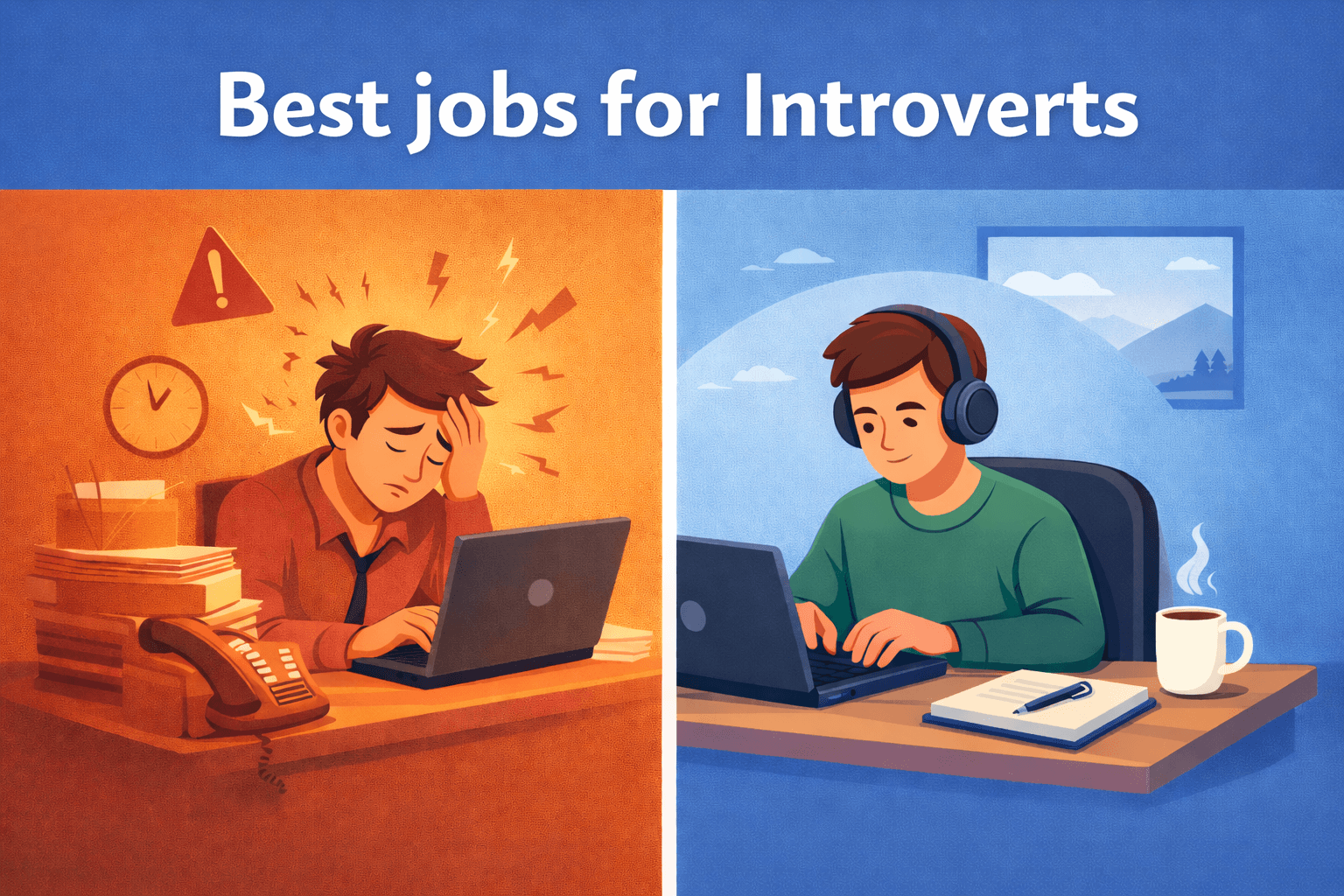
Some jobs sound perfect for introverts… until you actually do them every day.
You leave a loud job thinking, “This will finally feel better.”
Then a few weeks in, you’re still drained. Just in a quieter way.

Less talking.
But more mental fatigue.
Less pressure.
But more boredom or isolation.
If that’s happened to you, you didn’t choose the wrong job title.
You chose the wrong type of work.
This guide will help you avoid that mistake and choose something you can actually stick with.
This article is for people who:
- feel drained after too much interaction
- dislike fake networking energy
- struggle with repetitive or socially exhausting jobs
- want quieter work without feeling isolated or bored
- are trying to find work that actually fits their brain long-term
Quick Answer: Best Jobs for Introverts
If you want:
- high income potential → Software Developer or Data Analyst
- creative independent work → Graphic Designer or Writer
- predictable low-interaction work → Bookkeeper or Medical Coder
- structured writing work → Technical Writer
- very quiet environments → Archivist or Lab Technician
- The best fit depends less on “introvert vs extrovert”
- and more on:
- your tolerance for repetition
- your need for structure
- how you handle mental fatigue
- how much isolation affects your motivation
These jobs reduce constant interaction, but more importantly, they let you work without being “on” all day.
Reality Check:
A quiet job is not automatically a good introvert job.
Some introverts burn out from:
- repetitive work
- isolation
- slow progress
- being mentally stuck too long
- unclear expectations
The best introvert job is usually not:
→ “the quietest job”
It’s:
→ “the type of stress you can sustain long-term”
What Are the Best Jobs for Introverts?
The best jobs for introverts are not just quiet.
They are jobs where:
- you can focus without constant interruption
- communication is controlled, not nonstop
- the work itself doesn’t drain you in a different way
Most people get this wrong.
They optimize for less people, not for how the work feels after a few hours.
That’s why people switch into “quiet jobs” and still feel:
- mentally drained
- bored and unfocused
- stuck doing work that feels flat
The Introvert Work Fit Model (Unique Framework)

Not all introverts want the same type of work.
Some need creativity and variety.
Others prefer structure and predictability.
That’s why the same “perfect introvert job” can energize one person and drain another.
Most people pick jobs based on titles. That’s why they get stuck.
Use this instead:
1. Interaction Level
- Low → almost no meetings, mostly solo
- Medium → occasional collaboration
2. Work Style
- Structured → repeating the same type of task
- Flexible → creating, solving, deciding what to do next
3. Mental Load (this is where most people get it wrong)
- Low strain → easier to sustain, but can feel slow or dull
- High strain → engaging, but can feel exhausting
Your best job is where all three match.
Examples:
- Low interaction + structured + low strain → calm, but can drag by mid-day
- Low interaction + flexible + high strain → engaging early, frustrating when you get stuck
If a “quiet job” didn’t work for you before, it’s usually this third factor.
Not Sure Which Career Fits You?
Answer 7 questions to narrow your options based on your work style, preferred environment, and daily work preferences.
Best Jobs for Introverts (With Real Insights)
Software Developer
- Interaction level: Low to medium
- Communication style: Mostly written
You build or maintain software systems.
Why it fits:
- Long stretches of uninterrupted work
- Minimal meetings in many roles
Best for:
- People who can sit with a problem even when nothing is working
- People who don’t need constant feedback
Avoid if:
- Getting stuck quickly drains your energy
- You need visible progress to stay motivated
Typical salary range:
- Often ranges from $90k–$150k+ depending on specialization, company, and experience.
Skills:
- Learn HTML/CSS/JavaScript or Python
- Build 2–3 small projects yourself
- Apply to junior, freelance, or internship-style roles
How to start:
- Tutorials feel clean and logical because everything works
- The shift happens when you build something yourself and it breaks in ways you don’t understand
- You’ll spend time isolating one issue, fixing it, then realizing something else broke instead
Reality check:
- There are stretches where you’ve been working for hours and nothing works yet
- A bad stretch feels like trying fix after fix without knowing if you’re even solving the right problem
- By the afternoon, it can feel like you’ve made no progress, even though you’ve been focused the entire time
Graphic Designer
- Interaction level: Low to medium
- Communication style: Feedback-driven
You create visuals for brands or products.
Why it fits:
- Most work is done independently
- You control execution
Best for:
- People who can revise the same work multiple times without frustration
- People comfortable with subjective feedback
Avoid if:
- You want clear right/wrong answers
- You get stuck when direction keeps changing
Typical salary range:
- Often ranges from $50k–$90k+ depending on niche, portfolio strength, and experience.
Skills:
- Learn Canva, Figma, or Adobe tools
- Create sample logos, social posts, or mock websites
- Build a small portfolio before applying
How to start:
- It’s easy to make something that looks good once
- It’s harder to make multiple versions that each solve a specific purpose (layout, clarity, hierarchy)
- Early on, you’ll often feel like you’re guessing what works instead of knowing
Reality check:
- Some days are just cycles of feedback and small adjustments
- A bad stretch feels like changing spacing, colors, and alignment over and over without moving forward
- You can finish the day feeling like you worked a lot but didn’t actually finish anything
Data Analyst
- Interaction level: Low
- Communication style: Reports
You work with data to find patterns.
Why it fits:
- Most tasks follow a logical process with clear objectives and measurable progress.
- A large portion of the work is done independently, which reduces constant interruptions and social fatigue.
Best for:
- People who like step-by-step work
- People who don’t mind repetition with small variation
Avoid if:
- You need variety to stay engaged
- Repetition drains you quickly
Typical salary range:
- Often ranges from $65k–$110k+ depending on industry and technical skills.
Skills:
- Learn Excel and SQL first
- Practice cleaning messy datasets
- Build portfolio dashboards using public datasets
How to start:
- Clean datasets make everything look straightforward
- Real datasets are inconsistent, duplicated, or missing pieces
- You’ll spend time figuring out why numbers don’t match before you can analyze anything
Reality check:
- A lot of the job is fixing small issues across large datasets
- A bad stretch feels like checking the same type of inconsistency across hundreds of rows
- The mental strain comes from staying precise, not from doing something new
Writer / Editor
- Interaction level: Low
- Communication style: Fully written
You create or refine content.
Why it fits:
- Flexible, independent work
- No constant interaction
Best for:
- People who can work without waiting to feel motivated
- People comfortable being alone with their thoughts
Avoid if:
- You rely on inspiration to start
- You need external pressure to stay consistent
Typical salary range:
- Often ranges from $50k–$100k+, but income varies heavily by niche and consistency.
Skills:
- Start publishing writing consistently
- Create 3–5 strong writing samples
- Apply to freelance, editing, or content roles
How to start:
- Writing occasionally feels easy
- Writing consistently means starting even when your brain feels blank
- You’ll often write something that doesn’t work, then slowly reshape it
Reality check:
- There are stretches where you reread the same paragraph trying to fix it
- A bad stretch feels like forcing sentences that don’t sound right no matter how you tweak them
- Progress can feel slow because small improvements take time
Bookkeeper
- Interaction level: Low
- Communication style: Occasional
Why it fits:
- The work is predictable and usually follows repeatable systems.
- You often know exactly what needs to be done, which reduces social pressure and decision fatigue throughout the day.
Best for:
- People who like routine
- People who can stay focused on details
Avoid if:
- You need novelty
- You lose focus with repetition
Typical salary range:
- Often ranges from $45k–$75k depending on experience and clients.
Skills:
- Learn QuickBooks basics
- Practice bookkeeping exercises
- Apply to small business bookkeeping roles
How to start:
- The rules are simple at first
- The difficulty is maintaining accuracy across many small entries
- One missed detail can throw off totals later
Reality check:
- Early in the day, it feels clean and manageable
- A bad stretch hits when entries start to blur together and you have to double-check everything
- The work doesn’t get harder, but your focus gets harder to maintain
Medical Coder
- Interaction level: Very low
You convert medical records into codes.
Why it fits:
- The work follows strict systems with very little ambiguity.
- Most of the day is spent working independently without constant meetings, customer interaction, or unpredictable collaboration.
Best for:
- People who prefer strict systems
- People who can stay precise for long periods
Avoid if:
- You want creative work
- Repetition drains you quickly
Typical salary range:
- Often ranges from $45k–$80k depending on certification and specialization.
Skills:
- Learn medical coding systems
- Complete a certification program
- Apply to remote coding or healthcare admin roles
How to start:
- You learn a fixed system with specific rules
- The challenge is applying those rules consistently across different records
- Small inconsistencies can cause mistakes if you rush
Reality check:
- The work is repetitive by design
- A bad stretch feels like reviewing similar records while trying not to miss small differences
- The difficulty is staying mentally sharp even when nothing changes
Technical Writer
- Interaction level: Low
You write structured documentation.
Why it fits:
- The work is structured around explaining systems clearly instead of constant social interaction.
- You usually work independently with defined goals, which can feel calmer than fast-moving collaborative environments.
Best for:
- People who like explaining things clearly
- People who prefer structure over open-ended work
Avoid if:
- You want full creative freedom
- You dislike breaking things into steps
Typical salary range:
- Often ranges from $70k–$120k+ depending on industry and technical complexity.
Skills:
- Learn how to explain systems clearly
- Rewrite technical processes into step-by-step instructions
- Build writing samples from real software or tools
How to start:
- Knowing how something works is not enough
- You need to break it into steps someone else can follow without confusion
- The hard part is deciding what to include and what to leave out
Reality check:
- You may spend long stretches rewriting the same explanation for clarity
- A bad stretch feels like reorganizing the same steps without improving them
- Progress is slow because clarity takes effort
Salary Comparison Table
Quick Job Comparison:
Use this as a fast scan, not a final decision. *Salary ranges vary by experience and location.
| Job | Typical Pay | Training Path |
|---|---|---|
| Software Developer | High ($90k–$150k+) | Degree, bootcamp, or self-taught projects |
| Graphic Designer | Mid-range ($50k–$90k+) | Portfolio-based |
| Data Analyst | Mid to high ($65k–$110k+) | Courses, degree, or portfolio projects |
| Writer / Editor | Varies widely ($50k–$100k+) | Portfolio-based |
| Bookkeeper | Mid-range ($45k–$75k) | QuickBooks or bookkeeping basics |
| Medical Coder | Mid-range ($45k–$80k) | Certification usually required |
| Technical Writer | Mid to high ($70k–$120k+) | Writing samples + technical understanding |
Sources:
U.S. Bureau of Labor Statistics (BLS), Glassdoor, Indeed, ZipRecruiter, and salary aggregation estimates reviewed in 2026.
The mistake most introverts make is choosing based only on interaction level.
A quieter job can still drain you if:
- the work feels repetitive
- progress feels invisible
- you stay mentally stuck too long
- isolation slowly kills motivation
That’s why some introverts love coding while others hate it.
And why some people thrive remotely while others slowly burn out.
The best job is usually not:
→ “the quietest job”
It’s:
→ “the type of stress you can sustain long-term”
Unexpected Jobs That Can Be Great for Introverts
Archivist
Quiet, structured work.
A bad stretch can feel slow, with long periods where nothing changes and progress is hard to see.
Librarian (Specialized)
More independent than expected.
Helping people throughout the day can break your focus more than you expect.
Lab Technician
Hands-on work.
Repeating the same process over and over can feel physically and mentally draining by the end of the day.
Transcriptionist
Very low interaction.
A bad stretch feels like trying to stay focused while listening and typing for long periods without losing accuracy.
Quality Control Inspector
Simple tasks.
The challenge is staying alert when each check feels almost identical to the last.
Where Introverts Get This Wrong (Critical Section)
Most people assume:
→ “If I remove people, I’ll feel better.”
What actually happens:
- You remove social exhaustion
- But replace it with mental fatigue, boredom, or isolation
That’s where the confusion comes from.
Nothing feels “wrong.”
But it doesn’t feel right either.
The real decision is not:
→ “Do I want people or not?”
It is:
→ “What type of drain can I handle long-term?”
How to Choose the Right Job as an Introvert

Step 1: Identify your main drain
- People drain you → choose low interaction
- Repetition drains you → avoid structured roles
- Mental strain drains you → avoid high-complexity roles
Step 2: Match your work style
- Prefer routine → structured jobs
- Prefer variety → flexible jobs
Step 3: Match your mental tolerance
- Need lower strain → simpler, repetitive roles
- Want engagement → problem-solving roles
Decision Rules (Fast Way to Choose)
- If you want predictable work → Bookkeeper or Medical Coder
- If you want creative work → Designer or Writer
- If you want higher income potential → Developer or Data Analyst
- If you want very low interaction → Transcription or coding-related roles
Quick Start (If You’re Still Unsure)
Start here:
Safest first choice (low overwhelm):
→ Bookkeeper or Medical Coder
If repetition drains you:
→ Designer or Writer
If you want higher upside (but harder early):
→ Software Developer
If none of these feel right:
→ You’re not choosing the wrong job
→ You’re choosing the wrong type of energy demand
Quick Comparisons (Avoid Picking the Wrong Job)

Software Developer vs Data Analyst
- Developer → more problem-solving, more frustration when stuck
- Analyst → more repetition, less uncertainty
- Avoid developer if being stuck drains you
- Avoid analyst if repetition drains you
Writer vs Technical Writer
- Writer → flexible, but requires consistency
- Technical writer → structured, but less creative
- Avoid writing if you struggle to produce regularly
- Avoid technical writing if structure feels limiting
Bookkeeper vs Medical Coder
- Bookkeeping → slightly more flexible
- Coding → stricter systems
- Both become repetitive
- Avoid both if repetition drains you quickly
Skills That Help Introverts Succeed
- Deep focus
- Written communication
- Independent problem-solving
- Time management
Tips for Thriving as an Introvert at Work
- Reduce unnecessary meetings
- Default to written communication
- Protect focused work time
- Build repeatable routines
You don’t need a perfect job.
You need one that drains you in a way you can sustain.
FAQs About Jobs for Introverts
What introvert jobs have the least meetings?
Roles like medical coding, bookkeeping, technical writing, transcription, and data analysis often involve fewer meetings and more independent work.
Are remote jobs always better for introverts?
Not always. Remote work can reduce social exhaustion, but too much isolation or written communication can create different types of burnout.
What introvert jobs become mentally draining over time?
Highly repetitive jobs, overly isolated work, or jobs where progress feels invisible can slowly become draining even if they are quiet.
What jobs fit introverts who hate being stuck?
Structured roles with predictable progress, like bookkeeping or data analysis, are often easier to sustain than highly open-ended problem-solving work.
What jobs fit introverts who hate repetition?
Creative or flexible roles like design, writing, or UX work may feel more engaging long-term than highly repetitive administrative work.
What’s the biggest mistake introverts make when choosing a career?
Most people optimize only for low interaction. But quiet jobs can still burn you out if the work style, repetition level, or mental strain doesn’t fit you.
What are high-paying jobs for introverts?
Software development, data analysis, and technical writing are commonly reported options.
Not Sure Which Career Fits You?
Answer 7 questions to narrow your options based on your work style, preferred environment, and daily work preferences.

His work has reached millions through platforms like The Good Men Project, Fatherly, and Quora, where he shares practical advice for introverts and people with anxiety.
He writes about jobs for introverts, low-stress careers, and how to build a work life that fits your personality.