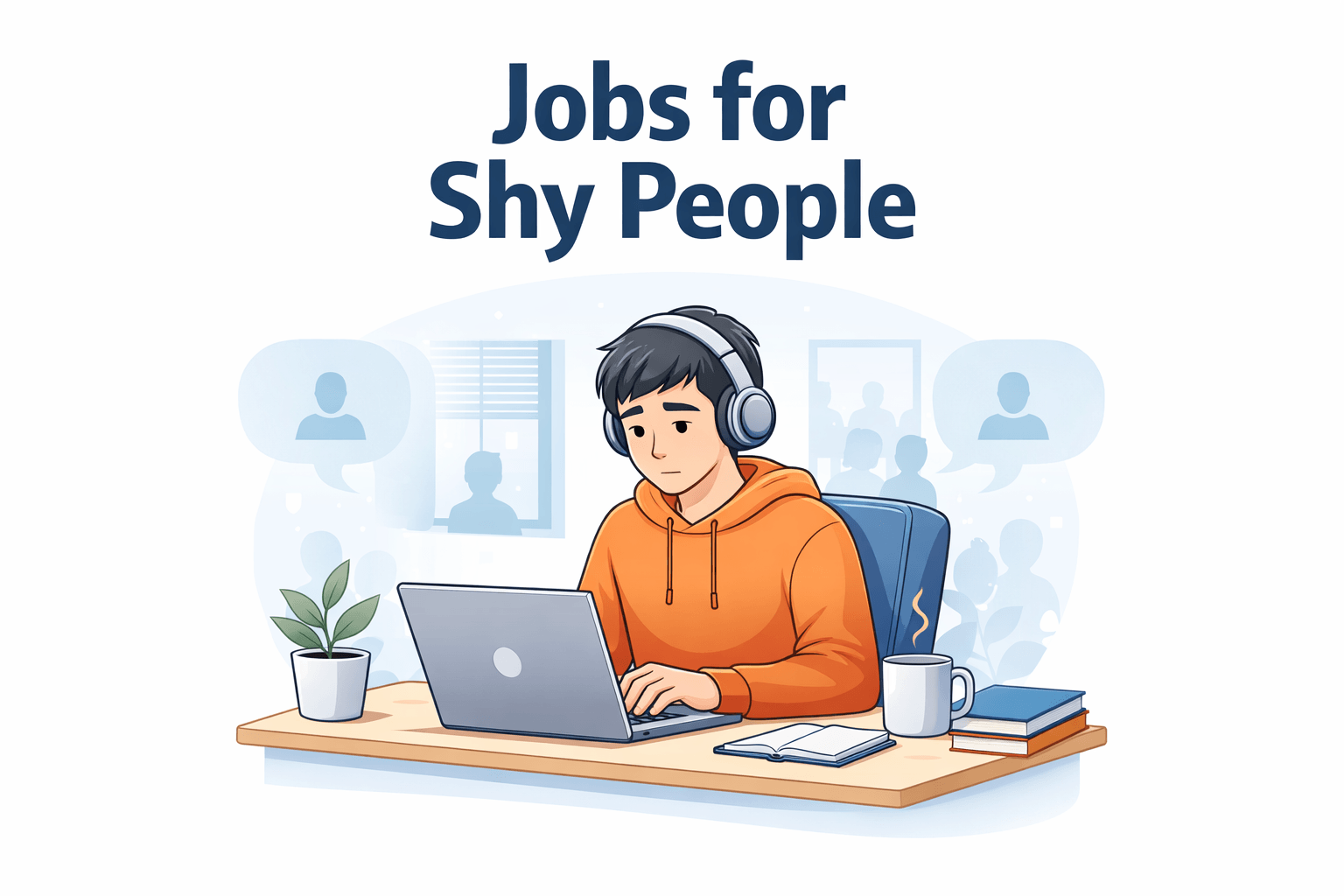
If you’re shy, socially awkward, or drained by constant interaction, most career advice feels useless.
It tells you to network more.
Speak up more.
Sell yourself more.
Get better at interviews.
Get comfortable being uncomfortable.
Some of that advice is not wrong.
But for a lot of people, it misses the real issue.

The real issue is not that you are lazy, incapable, or “bad with people.”
The real issue is that many jobs are built around real-time performance:
- speaking fast
- reacting fast
- answering on the spot
- being visible all day
- handling constant interruptions
And if that environment works against you, it can make you look worse than you actually are.
That is why a shy person can feel average in one job and deeply competent in another.
This guide is built to do three things:
- help you stop guessing
- help you pick the right type of job faster
- help you stop wasting time on paths that sound good but fit badly
Best Jobs for Shy People (Quick List)
If you want a fast answer, these are some of the best jobs for shy people:
- Writer or Copywriter
- Data Analyst
- Graphic Designer
- Bookkeeper or Accountant
- Software Developer
- Medical Coder
- SEO Specialist
- Video Editor
- Technical Writer
These jobs work well because they reduce real-time pressure, rely more on written or structured communication, and allow for focused, independent work.
If you want a better fit, keep reading — because the right job depends on the type of pressure that drains you most.
Stop Guessing Which Job Fits You
Take the free 2-minute quiz and get personalized career recommendations.
What Are the Best Jobs for Shy People?
The best jobs for shy people are jobs with:
- low or predictable interaction
- fewer meetings and interruptions
- clear tasks and expectations
- more written communication than verbal pressure
- space for focus, independent work, and thoughtful output
That matters more than whether a job “sounds quiet.”
A job can look calm on paper and still drain you every day.
The Real Reason You Struggle Isn’t Shyness — It’s Real-Time Pressure
This is the biggest insight in the whole article.
Most people think the problem is:
“I’m shy, so I need a quiet job.”
That is too vague.
The real problem is usually this:
you do badly in real-time performance environments, not in work itself.
That includes:
- meetings where you are expected to answer fast
- roles with constant customer contact
- jobs where people interrupt you all day
- environments where confidence is judged instantly
But many shy people do very well in:
- delayed-response environments
- written communication
- task-based work
- deep-focus work
- structured problem-solving
That is why someone can feel terrible in sales and excellent in analysis.
Why someone can freeze in meetings but write brilliantly alone.
Why someone can hate customer support but thrive in development, design, editing, SEO, bookkeeping, or records-based work.
You do not need a different personality.
You need a different work structure.
Pick Your Job (No Thinking Required)

Use this first.
Do not start by comparing 25 jobs.
Start by matching the problem.
If you overthink everything you say
Pick:
- writer
- copywriter
- editor
- SEO specialist
These let you think first and respond in writing.
If you hate being put on the spot
Pick:
- software developer
- web developer
- medical coder
- archivist
These reduce live-pressure moments.
If you hate meetings
Pick:
- writer
- video editor
- developer
- records-based roles
These are usually more task-driven than meeting-driven.
If you hate customers
Pick:
- data analyst
- software developer
- cybersecurity analyst
- editor
- bookkeeper
These are far better than customer support, retail, or sales.
If you want high pay with lower social pressure
Pick:
- software developer
- data analyst
- cybersecurity analyst
- technical writer
- UX designer
These are harder to enter, but often better long-term.
If you want the fastest path without a degree
Pick:
- writer
- freelance SEO
- web developer
- video editor
- data entry or records-based roles as a short-term bridge
If you want structure and predictability
Pick:
- bookkeeper
- accountant
- medical coder
- librarian
- archivist
That is the first filter.
Now go deeper.
If You Feel Like This, Read This First
This section matters because a lot of readers do not need “job ideas.”
They need to feel understood before they act.
If this sounds like you:
- you rehearse what you want to say and still do not say it
- you know the answer in meetings but someone else says it first
- you avoid applying because the interview feels draining before it even happens
- you replay conversations after they happen
- you feel capable, but the social part makes you look less capable than you are

Then your problem is probably not intelligence, work ethic, or potential.
Your problem is exposure to the wrong kind of pressure.
That is why the right job can change how confident you feel surprisingly fast.
One Short, Realistic Transformation Story
A common pattern looks like this:
Someone starts in a customer-facing role because it was available.
They spend all day answering quickly, dealing with people, and trying to look energetic.
They go home drained and start believing they are bad at work.
Then they move into a more task-based role, like reporting, content, bookkeeping, design, or operations support.
Same person.
Same brain.
Same effort.
But now the environment changes:
- fewer interruptions
- fewer live reactions
- more time to think
- more written communication
- more control over focus
Within a few months, they look more competent.
Not because they transformed.
Because the work stopped fighting how they operate.
That is the shift you are trying to create.
Why You’re Still Stuck (Even After Reading Articles Like This)
This is the part people do not like hearing.
You are not always stuck because there are no good jobs.
A lot of the time, you are stuck because of behavior:
- overthinking
- endless research
- comparing too many paths
- waiting to feel ready
- quitting when the learning phase feels awkward
- restarting every time discomfort shows up
That is a trap.
Every good path on this page has a phase where you will feel:
- slow
- confused
- underqualified
- unsure whether you picked right
That is normal.
The people who get results are not always the most confident.
Often they are just the people who stay with one thing long enough to get through the ugly beginning.
The 2 Types of Shy People (And Why Most Advice Fails)

This is the framework that makes the article harder to replicate.
Most articles treat “shy people” as one group.
That’s the mistake.
There are actually two common patterns — and they struggle for different reasons.
Type 1: The Pressure-Avoider
This person hates:
- being called on
- being watched
- being interrupted
- being forced to react quickly
Best job environments:
- async communication
- task-based work
- deep focus with minimal interruptions
Good fits:
- writer
- editor
- software developer
- video editor
- medical coder
- archivist
Type 2: The Social Overthinker
This person can do the work — but gets stuck in:
- overthinking responses
- replaying conversations
- worrying how they came across
- freezing when explaining things on the spot
Best job environments:
- structured communication
- time to think before responding
- predictable expectations
Good fits:
- data analyst
- SEO specialist
- designer
- technical writer
- accounting or bookkeeping
Most people choose the wrong job because they ask:
“What sounds good?”
Instead of:
“What kind of pressure drains me?”
That one shift changes everything.
Stop Guessing Which Job Fits You
Take the free 2-minute quiz and get personalized career recommendations.
Best Jobs for Shy People: Deep Breakdown of the Top Options
1. Software Developer
Interaction level: Low
Communication style: Mostly written, task-based, async
Best for: People who like solving problems quietly and can tolerate confusion
Software development is one of the best modern careers for shy people because a lot of the job happens in deep focus. You are usually judged more by what you build than how charismatic you are in meetings.
What you actually do
- build features
- fix bugs
- read and understand existing code
- test solutions
- document or update work
What your day actually feels like
A lot of time alone, trying to figure out something that is not obvious.
This is not a job where every day feels smooth.
Many days feel like slow progress.
Most people fail here because
They think confusion means they are not smart enough.
It does not.
Confusion is part of the work.
This is where you’ll want to quit
When you have spent hours stuck on one issue and feel like you are getting nowhere.
If you push past this, you’re good
Because the people who succeed are usually the people who can stay calm longer inside confusion.
What beginners mess up
- jumping between too many languages
- taking courses without building anything
- avoiding Git and version control
- waiting too long to apply
What looks easy but isn’t
Learning syntax is easy compared to solving real problems inside messy code.
How to start
- Learn one language
- Build 2–3 small projects
- Learn Git
- Apply before you feel ready
2. Data Analyst
Interaction level: Low to medium
Communication style: Structured, report-based, occasional meetings
Best for: Logical thinkers who like patterns and can handle ambiguity
Data analysis is a strong fit for shy people because much of the job is independent. You are working with information, patterns, reporting, and business questions—not performing socially all day.
What you actually do
- clean data
- analyze trends
- build dashboards
- answer business questions
- explain findings clearly
What your day actually feels like
Less social chaos, but not zero communication. Most talking is purposeful and tied to the work.
Most people fail here because
They stay stuck in “learning mode” and never build real examples.
This is where you’ll want to quit
When the data is messy, the question is vague, and someone still wants a clean answer quickly.
If you push past this, you’re good
Because data work always includes ambiguity. If you stop expecting perfect clarity, you get much better.
What beginners mess up
- focusing only on tools, not business questions
- building dashboards that say nothing useful
- waiting until they feel “ready” to apply
What looks easy but isn’t
A clean dashboard can hide a lot of messy thinking underneath.
How to start
- Learn Excel
- Learn basic SQL
- Practice with public datasets
- Build 2–3 portfolio projects
3. Writer or Copywriter
Interaction level: Low
Communication style: Written
Best for: People who think more clearly in writing than in conversation
Writing is one of the best jobs for shy people because written communication is the work. You do not need to be fast out loud. You need to be clear on the page.
What you actually do
- research topics
- write drafts
- revise
- organize information
- match writing to audience and goal
What your day actually feels like
A mix of thinking, drafting, editing, doubting, and rewriting.
Most people fail here because
They confuse “I like writing” with “I can write consistently under deadline.”
This is where you’ll want to quit
When you are stuck, uninspired, and still need to produce.
If you push past this, you’re good
Because professional writing gets easier when you stop waiting to feel ready and learn to draft badly first.
What beginners mess up
- writing without a clear audience
- over-editing before finishing
- taking too many courses without publishing
- avoiding a niche
What looks easy but isn’t
Clear writing is much harder than people think.
How to start
- Pick a niche
- Write 3–5 strong samples
- Publish them somewhere
- Start applying to freelance or entry roles
4. Graphic Designer
Interaction level: Low to medium
Communication style: Feedback-based
Best for: Creative people who want to communicate visually more than verbally
Design can work well for shy people because the output matters more than your ability to command a room. But this is not quiet art time. It is problem-solving plus feedback.
What you actually do
- create layouts
- design assets
- revise work
- solve visual communication problems
- work inside brand or client constraints
Most people fail here because
They take feedback personally and get too attached to first drafts.
This is where you’ll want to quit
When vague feedback sends you back into another revision loop.
If you push past this, you’re good
Because the people who last learn to separate their identity from the work.
What beginners mess up
- prioritizing style over communication
- building a random portfolio with no direction
- ignoring typography and layout fundamentals
What looks easy but isn’t
Client feedback and revision culture.
How to start
- Learn core tools
- Study layout, hierarchy, and typography
- Build targeted portfolio pieces
- Start with freelance, contract, or junior roles
5. SEO Specialist
Interaction level: Low
Communication style: Written, reporting, async collaboration
Best for: People who like strategy, research, pattern recognition, and long-term wins
SEO is a good fit for shy people because a lot of the work is independent and analytical. You spend time researching what people search for, improving pages, and measuring results.
What you actually do
- keyword research
- content optimization
- on-page improvements
- performance analysis
- internal linking and strategy
Most people fail here because
They chase tricks instead of learning search intent and content quality.
This is where you’ll want to quit
When you do real work and the result takes time.
If you push past this, you’re good
Because this field rewards consistency more than short bursts of excitement.
What beginners mess up
- learning theory without running a real page
- obsessing over hacks
- quitting before anything compounds
What looks easy but isn’t
Ranking content consistently.
How to start
- Learn search intent and on-page basics
- Practice on a real site
- Track changes
- Build proof from results
Stop Guessing Which Job Fits You
Take the free 2-minute quiz and get personalized career recommendations.
20 More Good Jobs for Shy People (Brief but Useful List)
These are worth considering if the top 5 are not the right fit.
Web Developer
Builds and maintains websites. Good if you want technical work with less product complexity than some software roles.
Video Editor
Behind-the-scenes creative work. Good if you like focused, detail-heavy work and can tolerate revision rounds.
Technical Writer
Creates documentation, guides, and help content. Excellent if you are clear, organized, and prefer writing over speaking.
Editor
Improves clarity, flow, and structure in writing. Great for detail-focused people who like refining more than drafting.
Proofreader
Catches mistakes and cleans up copy. Lower-pressure than many creative jobs, but requires patience and focus.
Bookkeeper
A bookkeeper tracks financial records and transactions. Good for people who want structured, repetitive, predictable work.
Accountant
More advanced financial work with stronger pay potential. More communication than bookkeeping, but still structured.
Medical Coder
Quiet, detail-heavy, rules-based. Good if you want low interaction and high structure.
Records Clerk
Organizes and manages records and systems. Often a solid low-pressure option.
Archivist
Preserves and organizes records or historical materials. Quiet, focused, and detail-oriented.
Librarian
Calmer than many public-facing jobs, though not zero interaction. Good for organized people who like information systems.
Cybersecurity Analyst
Protects systems and investigates threats. Good pay, technical work, and often lower social chaos than many business roles.
QA Tester
Tests software for issues. Good if you like finding errors and working methodically.
GIS Analyst
Works with location-based data and mapping systems. Great for technical, analytical people.
Research Assistant
Supports research projects with data, sourcing, and organization. Often good for quiet, methodical workers.
Data Entry Specialist
Lower barrier to entry, though usually lower pay. Can be a short-term bridge role.
CAD Designer
Creates technical drawings and plans. Good if you like structured visual work.
Animator
Creative but often solitary work. Better for people who like patient, technical creativity.
UX Designer
Mix of design and problem-solving. Good long-term option, though some roles involve more meetings.
Court Reporter or Transcription Work
Highly structured language-based work. Good if you like precision and do not want heavy social exposure.
Jobs for Socially Awkward People
This query is slightly different from “jobs for shy people.”
If awkwardness or social anxiety is the bigger issue, prioritize jobs with:
- fewer live interactions
- less spontaneous speaking
- clear expectations
- lower social evaluation pressure
Best options:
- writer
- software developer
- editor
- data analyst
- medical coder
- video editor
- records-based roles
Avoid:
- sales
- customer support
- recruiting
- hospitality
- high-meeting client roles
Jobs With No Meetings (Or Close to It)
No job is guaranteed to have zero meetings, but some come much closer than others.
Best bets:
- writer
- video editor
- software developer on the right team
- medical coder
- proofreader
- records clerk
- archivist
The real lesson:
Do not just evaluate the role.
Evaluate the company culture too.
A good job inside a bad meeting culture can still feel awful.
Jobs With No Customer Interaction
A lot of readers do not hate work.
They hate customer-facing work.
That is a huge difference.
If you want jobs with little or no customer interaction, start here:
- software developer
- data analyst
- editor
- bookkeeper
- medical coder
- cybersecurity analyst
- records clerk
- QA tester
These are usually much better than:
- retail
- front desk work
- support
- sales
- call-center jobs
Easiest Jobs for Introverts and Shy People
“Easy” depends on what you mean.
If you mean easiest to start:
- writer
- freelance SEO
- data entry
- proofreading
- some admin or records roles
If you mean easiest socially:
- writer
- video editor
- medical coder
- proofreader
- archivist
If you mean easiest mentally:
Probably none of the better-paying ones.
Higher pay usually comes with steeper learning.
That is the tradeoff:
easy entry vs better long-term leverage.
Low-Stress Jobs for Shy People
Low stress usually means:
- fewer interruptions
- predictable communication
- clearer expectations
- steadier workload
Good options:
- archivist
- librarian
- medical coder
- records clerk
- bookkeeper
- proofreader
But here is the truth:
Low stress often trades off with either pay, speed of growth, or availability.
That does not make those jobs bad.
It just means you should be realistic.
High-Paying Jobs for Shy People
These are often the best long-term plays if you want skill-based leverage:
- software developer
- data analyst
- cybersecurity analyst
- UX designer
- technical writer
- SEO specialist in the right role
These jobs usually pay better because they are harder to enter.
That is the deal:
more learning upfront, less social chaos later.
Jobs for Shy People Without a Degree
This matters because many readers do not want to go back to school.
Some of the best no-degree or low-degree paths include:
- writer
- copywriter
- freelance SEO
- web developer
- video editor
- proofreader
- data entry or records roles as a bridge
The main rule:
Proof beats theory.
That means:
- projects
- portfolios
- samples
- case studies
- evidence you can do the work
Not endless certifications with no proof.
Light Authority Perspective
Reality Check (Backed by Real Data)
According to the U.S. Bureau of Labor Statistics, roles like software development, data analysis, and technical writing continue to show strong demand and long-term growth.
Many of these roles also rely more on structured or asynchronous communication — which makes them a better fit for people who struggle with constant real-time interaction.
That’s why jobs like development, analysis, writing, and records-based work are worth serious attention.
Comparison Table: Choose Faster
| Job | Interaction Level | Difficulty to Enter | No Degree Friendly | Best For |
|---|---|---|---|---|
| Software Developer | Low | High | Sometimes | Problem-solvers |
| Data Analyst | Low–Medium | Medium | Sometimes | Logical thinkers |
| Writer | Low | Medium | Yes | Strong written thinkers |
| Graphic Designer | Low–Medium | Medium | Yes | Visual thinkers |
| SEO Specialist | Low | Medium | Yes | Strategic thinkers |
| Bookkeeper | Low–Medium | Medium | Sometimes | Organized, detail-focused people |
| Medical Coder | Very Low | Medium | Sometimes | Structured, rule-based thinkers |

What’s a Waste of Time
This section needs to exist because readers need help avoiding bad moves.
Here is what wastes time:
- reading 15 articles and choosing nothing
- taking course after course without building proof
- jumping between three career paths every month
- waiting until you feel confident
- picking a job because it sounds respectable, not because it fits
- assuming “remote” automatically means “low stress”
That is how people stay stuck for a year and call it research.
Your Next 7 Days (Do This)

This is where the article closes the loop.
Day 1
Pick one path.
Not three.
Not “maybe.”
One.
Day 2
Read basic role descriptions and verify requirements from reputable sources like the BLS or actual job listings.
Day 3
Choose one beginner skill to learn first.
Day 4
Start learning that skill.
Do not binge random content.
Learn with a clear output in mind.
Day 5
Create something small:
- a writing sample
- a spreadsheet project
- a dashboard
- a small web page
- a simple design piece
Day 6
Look at 10 real job listings.
Notice what repeats.
Day 7
Decide whether to keep going on this path for the next 30 days.
If yes, commit.
If no, switch once—not five times.
That is enough to break the research spiral.
How to Choose the Right Job (Fast)
If you’re stuck between options, don’t overthink it. Use this:
- If you hate being interrupted → choose async, focus-heavy work (writer, developer, editor)
- If you freeze when speaking → choose written or structured roles (SEO, data, technical writing)
- If you want low stress → choose predictable, repeatable work (bookkeeping, coding, records)
- If you want higher pay → choose skill-based roles with leverage (developer, data analyst, cybersecurity)
You don’t need the perfect answer.
You need a direction you can stick with long enough to see results.
Final Truth
You do not need to become a different person.
You need to stop choosing environments that punish how you naturally work.
The best job for a shy person is not the quietest-sounding one.
It is the one where:
- pressure is lower
- communication is more manageable
- focus is protected
- your value comes from output, not performance
That is what works.
Everything else wastes your time.
Take the free 2-minute quiz and get personalized career recommendations.
Stop Guessing Which Job Fits You
Take the free 2-minute quiz and get personalized career recommendations.

His work has reached millions through platforms like The Good Men Project, Fatherly, and Quora, where he shares practical advice for introverts and people with anxiety.
He writes about jobs for introverts, low-stress careers, and how to build a work life that fits your personality.