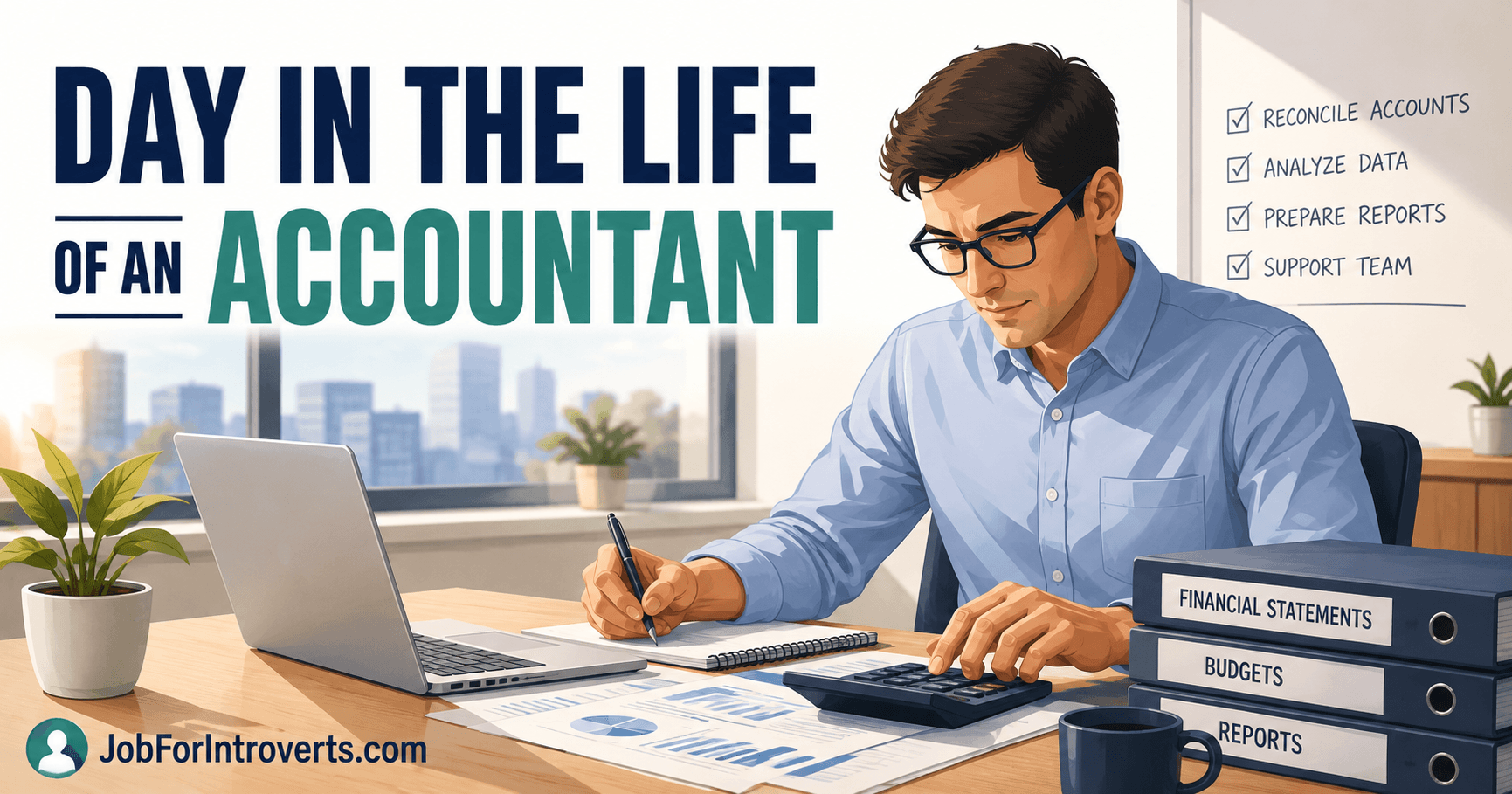
Day in the Life of an Accountant: What the Job Is Really Like
A typical accountant’s day may include reviewing messages, reconciling accounts, preparing journal entries, checking financial records, investigating discrepancies, and producing reports. Much of the work happens on a computer, but accounting is not automatically a solitary job. Accountants also request information, answer questions, work with colleagues, and explain financial results to managers, auditors, government agencies, or clients.
The exact experience depends heavily on the specialty and employer. A corporate accountant completing month-end close can have a very different schedule from a public accountant serving several clients or a government accountant reviewing public funds.
Research note: Occupational facts in this article come primarily from the U.S. Bureau of Labor Statistics and O*NET. A public discussion among accounting professionals is used only to illustrate how individual schedules and workplaces may differ. Those comments are personal experiences, not representative data.
A Realistic Day in the Life of an Accountant
The schedule below is an illustrative corporate-accounting day, not a claim that every accountant works these hours or follows this exact sequence. It combines duties identified by the Bureau of Labor Statistics and O*NET with recurring patterns described in a public discussion among accountants.

8:30 a.m. to 9:00 a.m.: Review messages and establish priorities
The day may begin with:
- Email and internal messages
- Deadlines and assigned tasks
- Requests from managers or other departments
- Questions about invoices, expenses, payments, or reports
- Unfinished work from the previous day
An accountant may already have a planned task list but need to reorganize it when a report is requested unexpectedly or another department cannot complete its work without financial information.
That is one overlooked part of accounting: the work often has structure, but it is not always uninterrupted.
9:00 a.m. to 11:30 a.m.: Complete detailed accounting work
A block of the day may be devoted to tasks such as:
- Reconciling bank or balance-sheet accounts
- Preparing or reviewing journal entries
- Checking transactions for missing information
- Reviewing expenses or invoices
- Updating financial statements
- Examining records for compliance
- Comparing spending with a budget
- Investigating why two records do not match
The Bureau of Labor Statistics describes accountants and auditors as professionals who prepare and examine financial records, evaluate accuracy and risk, assess financial operations, and make recommendations. O*NET identifies examining records, verifying information, analyzing financial data, preparing reports, calculating taxes, and developing financial systems among the occupation’s activities.
Most of this work is not advanced arithmetic performed by hand. Accountants use spreadsheets, accounting platforms, enterprise resource planning systems, tax software, document tools, and financial-analysis applications. O*NET lists tools such as Microsoft Excel, Google Sheets, QuickBooks, SAP, Oracle, Workday, tax-preparation programs, and other financial software within the occupation’s technology categories.
The difficult part is often understanding why something is wrong, deciding how a transaction should be recorded, or determining whether the available documentation is sufficient.
11:30 a.m. to 1:00 p.m.: Respond to questions and review work
Late morning may include a team discussion, review session, or questions from other departments.
Someone may ask:
- Which account should this expense use?
- Why does the report differ from the source data?
- Has an invoice been paid?
- What caused a budget variance?
- Is this transaction documented correctly?
- What information does the auditor still need?
An experienced accountant may also review another employee’s work, explain a correction, or request missing documentation.
BLS notes that accountants must explain their findings through written reports and meetings with managers or clients. O*NET also identifies speaking, writing, teamwork, external communication, and interpreting information for others as relevant work activities.
1:00 p.m. to 3:30 p.m.: Work on reports, analysis, or longer projects
Afternoon work may include:
- Preparing a monthly financial report
- Analyzing revenue or spending
- Updating a budget or forecast
- Documenting an accounting process
- Preparing information for an audit
- Researching an accounting rule
- Improving a spreadsheet or workflow
- Supporting an accounting-system or payroll conversion
This is where accounting can become more analytical than the job’s stereotype suggests. Recording transactions is only part of the occupation. Accountants also interpret financial information, identify risks, evaluate processes, and explain what the numbers mean.
3:30 p.m. to 5:00 p.m.: Review, follow up, and prepare for the next day
The final part of the day may involve:
- Checking completed work
- Following up on missing information
- Responding to messages
- Submitting reports for review
- Documenting unresolved discrepancies
- Updating task lists and priorities
During an ordinary week, the employee may finish near the end of the standard workday. During month-end close, an audit, tax season, or another major deadline, the workday may extend.
BLS reports that most accountants work full time and that longer work periods are typical at certain points of the year, including quarterly audits and tax season.
Not Sure Which Career Fits You?
Answer 7 questions to narrow your options based on your work style, preferred environment, and daily work preferences.
How the Workday Changes by Type of Accounting
“Accountant” is a broad title. The employer, specialty, client structure, and reporting cycle can alter both the tasks and the pressure.
| Accounting path | What the day often centers on | When pressure may increase | Typical communication |
|---|---|---|---|
| Public accounting | Audit, tax, consulting, and work for multiple clients | Tax filing periods, audits, client deadlines, and reporting dates | Accounting team members and external clients |
| Corporate or industry accounting | Internal reporting, reconciliations, close, budgets, and business support | Month-end, quarter-end, year-end, audits, and company projects | Managers, coworkers, auditors, and other departments |
| Government accounting | Public funds, compliance, auditing, reporting, and budgets | Reporting deadlines, investigations, audits, and staffing shortages | Government teams, agencies, and regulated organizations |
BLS distinguishes public, management or corporate, and government accounting based on whom the accountant serves and whether the work focuses on clients, internal decision-making, public funds, reporting, taxation, or auditing.
Public accounting
Public accountants work for accounting firms or operate their own practices. Their work may include auditing, tax preparation, consulting, forensic accounting, or financial advisory services for several clients.
This can provide exposure to different organizations and financial situations. BLS notes that entry-level public accountants may move into senior roles as they gain experience and take on more responsibility. Some later become managers, partners, firm owners, or move into corporate accounting or internal audit.
The tradeoff is that client deadlines, tax calendars, audits, and billable-work expectations may make the schedule less predictable.
Corporate or industry accounting
Corporate accountants work inside one organization. Their responsibilities may include:
- Journal entries
- Account reconciliations
- Financial reporting
- Budgeting
- Supporting internal departments
- Reviewing financial processes
- Preparing information for auditors
The work may follow a recurring monthly rhythm, but recurring does not mean consistently easy. Close periods, company acquisitions, payroll conversions, system implementations, and major reporting projects can create heavier weeks.
In the public r/Accounting discussion reviewed for this article, individual corporate accountants described work involving Excel, journal entries, reconciliations, review responsibilities, month-end close, unexpected requests, and quieter periods for lower-priority projects. These comments help illustrate possible experiences, but they should not be treated as a survey of the profession.
Government accounting
Government accountants maintain and examine agency records, review the handling of public money, complete financial reporting, and audit organizations subject to government rules or taxation.
Some government positions may have stable schedules and well-defined procedures. Others may involve older systems, manual processes, staffing gaps, or broad responsibilities. The title alone cannot tell you which environment you are entering.

What Accountants Spend Most of Their Time Doing
Accountants do not spend the entire day solving equations. The job usually combines recordkeeping, investigation, software use, review, judgment, and communication.
Reconciling accounts
A reconciliation compares two sources of financial information to determine whether they agree.
For example, an accountant may compare:
- Company records with a bank statement
- Invoices with payments received
- A payroll report with general-ledger entries
- Inventory records with an actual count
When the records do not match, the accountant investigates the cause. It may be a duplicate entry, timing difference, incorrect classification, omitted payment, or data-entry error.
Some people enjoy tracing a discrepancy until the records agree. Others find repeated reconciliation work tedious.
Preparing entries and financial reports
Accountants may prepare journal entries for revenue, expenses, payroll, accruals, depreciation, or corrections.
They may then help produce:
- Income statements
- Balance sheets
- Cash-flow statements
- Budget comparisons
- Audit schedules
- Internal management reports
Accuracy matters because these records may influence tax filings, business decisions, audits, payments, or financial statements.
Reviewing and verifying information
A substantial part of accounting involves checking information rather than creating something entirely new.
An accountant may verify:
- Whether documentation is present
- Whether an expense was classified correctly
- Whether policies were followed
- Whether a calculation appears reasonable
- Whether a report agrees with its underlying records
- Whether another employee’s work needs correction
O*NET identifies evaluating compliance, documenting information, processing data, verifying records, and monitoring performance as important activities within the occupation.
Explaining what the numbers mean
Accountants may need to explain why spending exceeded a budget, what caused a financial change, how an error should be corrected, or what a report shows.
This communication responsibility often increases with seniority. Advancement may involve reviewing employees’ work, advising managers, coordinating with auditors, improving processes, or supporting decisions.
The job may therefore become less solitary as responsibility grows.
How Much Interaction Does an Accountant Have?
Accounting is not a zero-interaction career.
O*NET identifies email, telephone conversations, face-to-face discussions, contact with others, teamwork, accuracy, deadlines, decision-making freedom, and repetitive tasks as significant parts of the occupation’s work context. These measures do not reveal the number of meetings in a particular job, but they challenge the idea that accountants simply work alone with spreadsheets all day.
Interaction may include:
- Asking coworkers for missing information
- Explaining a report to a manager
- Reviewing work with another accountant
- Meeting with an auditor
- Answering a client’s tax or financial question
- Following up with another department
- Training employees on a financial process
- Clarifying how a transaction should be recorded
The amount and style of communication vary substantially.
In the public discussion reviewed for this article, one remote industry accountant described having only a small number of meetings and informal calls in a normal week. Another remote accountant described frequent unplanned calls because coworkers relied on that person for reporting and system support. These are individual examples, but the contrast reveals why “remote accountant” does not automatically mean quiet or uninterrupted work.
Before pursuing a position, ask:
- Who relies on this accountant for answers?
- How many departments does the role support?
- Are questions handled through email or calls?
- Does the position serve external clients?
- Does it review or supervise other people?
- How often are priorities changed by a manager?
Is Accounting Repetitive or Stressful?
It can be both repetitive and demanding, but the balance depends on the role.
Where the repetition comes from
Recurring tasks may include:
- Monthly reconciliations
- Standard journal entries
- Repeated financial reports
- Transaction reviews
- Close checklists
- Document verification
O*NET identifies repeated mental activities, accuracy, sitting, computer work, and information processing as meaningful parts of the occupation.
That routine may feel satisfying when you enjoy clear procedures and measurable completion. It may become draining when you need constant novelty or dislike rechecking details.
Where the problem-solving comes from
A discrepancy does not always have an obvious cause. An accountant may need to trace information through several systems, understand a business process, interpret a reporting rule, or decide how unusual activity should be recorded.
More experienced roles may involve:
- Analysis
- Internal controls
- Systems improvement
- Financial planning
- Audit judgment
- Management reporting
- Tax or regulatory questions
The tradeoff is that more advanced responsibility often brings more decisions, review work, and communication.
Where the pressure comes from
Common pressure points include:
- Month-end or year-end close
- Tax and regulatory deadlines
- Audit requests
- Missing documentation
- Last-minute management questions
- Accounts that do not reconcile
- Responsibility for accurate financial records
- Repeated review corrections
- Long periods of detail-focused screen work
O*NET identifies accuracy, strict deadlines, teamwork, contact, and the effect of decisions on company results as important work-context factors. BLS also notes that longer working periods are typical during quarterly audits and tax season.
A useful way to think about many accounting roles is cyclical pressure: routine periods may be followed by predictable bursts of heavier work.

Accounting on Paper Versus Accounting in Reality
On paper: “You work quietly with numbers.”
In reality: The job may provide long periods of computer-based work, but accountants still need information from other people and must explain their findings.
On paper: “The work is predictable.”
In reality: Many duties follow monthly, quarterly, or annual cycles. Discrepancies, audit requests, missing records, and management questions can interrupt that schedule.
On paper: “It is a normal nine-to-five office job.”
In reality: Some positions maintain standard hours most of the year. Tax, audit, close, or reporting deadlines can extend the workday.
On paper: “Accounting is naturally good for introverts.”
In reality: It may suit someone who enjoys focused work and task-based communication. It may still be a poor fit for someone who dislikes repetition, accuracy pressure, deadline spikes, or requesting information from other people.
On paper: “Remote accounting means independent work.”
In reality: BLS confirms that some accountants work from home, but it also reports that accountants commonly work in teams. A remote employee may still spend substantial time in email, calls, meetings, reviews, and cross-department support.
Would You Enjoy Accounting? A Work-Fit Check
Accounting may fit you well when you prefer:
- Structured tasks and recurring work cycles
- Long periods of computer-based concentration
- Finding and correcting discrepancies
- Clear rules combined with analytical judgment
- Written or task-focused communication
- Work where accuracy can be checked
- A career with several possible specialties
- Interaction that usually has a practical purpose
You may want to reconsider it when:
- Rechecking details quickly frustrates you
- You need frequent creative novelty
- Financial mistakes create excessive stress for you
- You dislike sitting at a computer for much of the day
- You strongly dislike deadlines or recurring peak periods
- You want advancement without added communication or responsibility
- You do not want to ask coworkers or clients for missing information
- You want a profession with no meaningful education barrier
Introversion alone does not determine fit. An introvert can communicate effectively, lead a team, advise clients, or enjoy collaboration. The more useful question is whether the role’s combination of concentrated work, purposeful interaction, repetition, accuracy, and deadline pressure matches how you prefer to work.
Accounting appears on lists of the best jobs for introverts, but the employer’s systems, staffing, manager, review process, and workload expectations may matter more than the title.

How to Enter Accounting
BLS says accountants and auditors typically need at least a bachelor’s degree in accounting or a related field.
There are exceptions. BLS notes that some people with an associate degree—and some bookkeepers or accounting clerks who meet an employer’s education and experience requirements—may move into junior accounting positions and advance by demonstrating their skills. These are possible routes, not the standard requirement for the broader accountant and auditor occupation.
A realistic preparation path is:
- Learn financial-accounting fundamentals. Understand financial statements, journal entries, account classification, and reconciliations.
- Develop practical spreadsheet ability. Practice sorting, filtering, formulas, lookups, data cleanup, and comparing records.
- Complete realistic accounting exercises. Work through sample entries, reconciliations, and financial reports.
- Seek an internship or entry-level position. BLS identifies internships with public accounting or business firms as one way students gain practical experience.
- Study the software used in your target roles. Compare job descriptions to see whether employers repeatedly request Excel, QuickBooks, a particular ERP, tax software, or reporting tools.
- Decide whether CPA licensure supports your intended path.
CPA licensing is state-based. NASBA explains that education and work-experience requirements vary by jurisdiction, including what types of experience qualify. Prospective CPAs should review the rules of the state board where they plan to become licensed rather than relying on a single national summary.
Readers who want structured financial work without the typical bachelor’s-degree route can also compare jobs for introverts without a degree. Bookkeeping and accounting-support roles should not be treated as identical to professional accountant positions; they have different responsibilities, entry standards, pay, and advancement patterns.
How to Test Whether Accounting Fits Before Committing
You do not need to invest years in education before testing your reaction to the work.
Complete a simple reconciliation
Create two lists of transactions with several deliberate differences. Try to find:
- Missing transactions
- Duplicate transactions
- Incorrect amounts
- Timing differences
- Inconsistent descriptions
Notice how the process feels.
Do you enjoy tracing the cause until the records agree, or does the repeated checking immediately become frustrating?
Take an introductory accounting course
A low-cost college course or reputable online course can expose you to the logic of accounting before you make a larger commitment.
Do not judge the career only by whether the first lesson feels difficult. Pay attention to whether you enjoy the underlying process after you understand it.
Compare actual job descriptions
Review postings for titles such as:
- Staff accountant
- Corporate accountant
- Tax associate
- Audit associate
- Internal auditor
- Government accountant
Look for phrases such as:
- Month-end close
- Client-facing
- Multiple deadlines
- Cross-functional support
- Billable hours
- Frequent communication
- Travel required
- Fast-paced
- High-volume
- Review and supervision
Those phrases reveal more about the work environment than the title alone.
Speak with accountants in different settings
A public tax accountant, corporate staff accountant, internal auditor, and government accountant may describe four very different careers.
Ask:
- What takes up most of your day?
- What part of the month or year is busiest?
- How many meetings or calls do you have?
- What percentage of the work is recurring?
- How often do priorities change?
- What mistakes create the most pressure?
- What do new accountants misunderstand about the job?
Salary, Outlook, and Automation
O*NET’s current Accountants and Auditors profile, using 2025 BLS wage data, lists a U.S. median annual wage of $83,680. Earnings differ by location, experience, specialty, industry, employer, and credentials.
BLS projects employment of accountants and auditors to grow 5% from 2024 through 2034, with approximately 124,200 openings per year on average. Many projected openings are expected to result from workers transferring to other occupations or leaving the labor force, not only from newly created positions.
BLS expects technology to automate some routine activities, including certain data-entry work, while making analysis and advisory duties more prominent. It does not project that automation will eliminate overall demand for accountants during the projection period.
A reasonable implication is that the quietest and most repetitive parts of accounting may become less central over time, while judgment, analysis, systems knowledge, review, and explanation become more valuable. Those responsibilities may also require more communication. This is an interpretation of the BLS automation outlook combined with O*NET’s work-activity data, not a prediction about every individual position.
Questions to Ask Before Accepting an Accounting Job
Two positions with the same title can produce very different daily experiences.
Ask the hiring manager:
- What does a normal week look like outside the close period?
- How many days does month-end or quarter-end close usually take?
- How late does the team typically work during close, audits, or tax deadlines?
- How many recurring meetings does this position attend?
- How much of the role is planned work versus unexpected requests?
- Which departments or clients send the most requests to this person?
- How frequently do priorities change during the day?
- How is completed work reviewed, and how often is feedback provided?
- Which processes are still manual?
- Why is the position open?
- What created the most pressure for the previous person?
- What would successful performance look like after three months?
Listen for specific answers.
A manager who can clearly describe the close schedule, review process, communication expectations, systems, and workload peaks probably understands the position. Vague statements about constantly “wearing many hats” or doing “whatever it takes” do not prove that an employer is unhealthy, but they justify asking for more detail about responsibilities and staffing.
The guide on how to tell whether a job will drain you as an introvert provides additional questions about interruptions, management style, workload, and communication expectations.
The Bottom Line
Accounting may suit you when you enjoy structured problem-solving, careful review, financial systems, and focused computer work. It also requires communication, repeated checking, deadline management, and responsibility for information that may affect financial decisions.
Do not choose accounting only because it appears stable, quiet, or introvert-friendly. Test whether you enjoy the actual work, compare accounting paths, and investigate the employer’s close schedule, staffing, systems, communication expectations, and review process.
Still Comparing Careers?
The free Job Fit Quiz asks about your preferred work environment, communication style, structure, and daily-work preferences. It will not choose a perfect career for you, but it can help you narrow the options worth researching next.
Not Sure Which Career Fits You?
Answer 7 questions to narrow your options based on your work style, preferred environment, and daily work preferences.

His work has reached millions through platforms like The Good Men Project, Fatherly, and Quora, where he shares practical advice for introverts and people with anxiety.
He writes about jobs for introverts, low-stress careers, and how to build a work life that fits your personality.
- Day in the Life of an Accountant: What It’s Really Like – August 5, 2026
- What Skills Do You Need to Become a Virtual Assistant? – August 4, 2026
- The Reality of Working From Home: What It’s Really Like – August 2, 2026