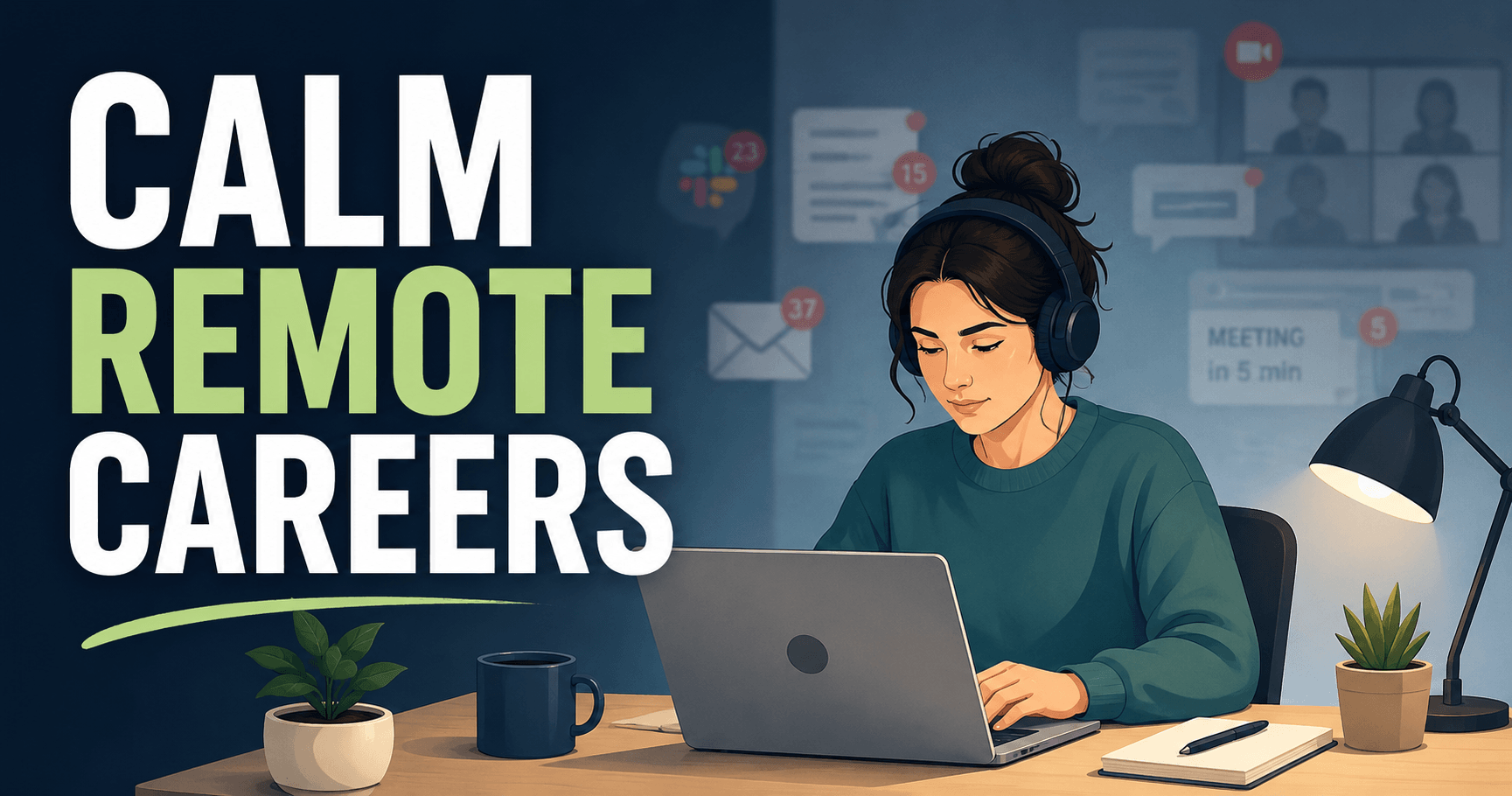
Finding a remote job as an introvert is not just about avoiding people.
It’s about avoiding work that leaves you mentally exhausted every day.
Some remote jobs feel calm, focused, and sustainable.
Others feel like sitting in a digital call center all day answering Slack messages, joining Zoom meetings, responding instantly, and pretending to be available every second.
That’s why many introverts discover something frustrating:
Working from home does not automatically mean low stress.
Some remote careers create more peace, focus, and independence.
Others quietly drain your energy through:
- nonstop interruptions
- constant notifications
- emotional labor
- customer pressure
- unpredictable communication
- meeting-heavy cultures

This guide breaks down remote careers based on:
- meeting load
- interruption level
- communication style
- emotional exhaustion risk
- independent focus time
- long-term sustainability
- beginner difficulty
Instead of just listing “quiet jobs,” this guide helps you understand what these careers actually feel like day to day so you can avoid ending up in a remote job that still burns you out.
Quick Answer: Best Remote Work Options for Introverts
Some of the best remote jobs for introverts include:
- Freelance writer
- Graphic designer
- Web developer
- SEO specialist
- Data analyst
- Bookkeeper
- Proofreader
- Transcriptionist
- Email or chat support specialist
- Video editor
These jobs often work well for introverts because they usually involve:
- more independent work
- fewer interruptions
- written communication
- quieter environments
- deeper focus
- more control over workflow
But the best remote job for you depends on something more specific:
What kind of social interaction drains you most?
Some introverts hate meetings.
Others dislike fast interruptions.
Others feel exhausted by emotional labor or customer-facing pressure.
The best fit depends on how your energy gets drained.
Stop Guessing Which Job Fits You
Take the free 2-minute quiz and get personalized career recommendations.
What Makes a Remote Job Good for Introverts?
A good introvert-friendly job is usually not a job with zero interaction.
It’s a job where communication feels predictable and manageable.
Most introverts do fine with:
- one-on-one conversations
- smaller groups
- structured collaboration
- written communication
- independent problem-solving
What usually becomes exhausting is:
- constant interruptions
- rapid-fire messaging
- emotional pressure
- unpredictable demands
- being expected to stay “on” socially all day
That distinction matters.
Two remote jobs can both sound introvert-friendly but feel completely different emotionally.
For example:
A remote data analyst may quietly spend hours solving problems independently.
A remote recruiter may spend the entire day jumping between calls, interviews, outreach messages, and follow-ups.
Both are remote.
Only one may feel sustainable for certain introverts.
What Quietly Exhausts Introverts at Work?
Many introverts think the problem is “working with people.”
Usually it’s not.
The bigger issue is often:
- nonstop context switching
- constant digital interruptions
- emotional labor
- lack of recovery time
- unclear expectations
- reactive communication cultures
Some work environments feel mentally noisy even when working from home.
Examples:
- Slack messages every few minutes
- managers expecting instant replies
- multiple meetings daily
- customer escalation pressure
- being monitored constantly online
- multitasking across conversations
A quieter remote job usually has:
- longer uninterrupted work blocks
- clearer expectations
- fewer urgent interruptions
- more asynchronous communication
- predictable workflows
That often matters more than the job title itself.

Best Remote Jobs by Energy Drain Type
Best for Introverts Who Hate Interruptions
These jobs usually allow longer uninterrupted focus blocks:
- Data analyst
- Bookkeeper
- Proofreader
- Web developer
- Transcriptionist
These careers tend to work better for people who feel mentally exhausted by constant notifications and context switching.
Best for Introverts Who Hate Meetings
These careers usually involve fewer scheduled calls:
- Freelance writer
- Proofreader
- Bookkeeper
- Video editor
- Transcriptionist
Many people searching for “quiet remote jobs” are actually trying to escape excessive meetings more than social interaction itself.
Highest Burnout Risk for Introverts
These jobs may sound introvert-friendly initially but often become emotionally draining over time:
- Chat support
- Recruiting
- Social media management
- High-volume customer success roles
- Fast-paced agency environments
The common problem is usually not people.
It’s nonstop responsiveness.
Most Peaceful Remote Jobs Overall
For many introverts, these careers tend to create the best balance of:
- independence
- focus
- lower interruption levels
- manageable communication
- predictable work
Examples:
- Bookkeeping
- Proofreading
- Data analysis
- Freelance writing
- GIS work
Quick Comparison: Which Remote Jobs Feel Most Introvert-Friendly?
Lowest Meeting Load
- Proofreader
- Transcriptionist
- Freelance writer
- Bookkeeper
Best for people who feel drained by constant Zoom calls or live collaboration.
Lowest Interruption Levels
- Data analyst
- Proofreader
- Bookkeeper
- Web developer
Best for introverts who lose focus easily when constantly interrupted.
Highest Emotional Exhaustion Risk
- Chat support
- Recruiting
- Customer success
- Social media management
These jobs often involve constant responsiveness and emotional labor.
Best for Deep Focus
- Video editor
- Data analyst
- Web developer
- Proofreader
Best for people who enjoy getting absorbed in one task for long periods.
Easiest Entry-Level Paths
- Chat support
- Transcription
- Basic content writing
- Virtual assistance
Usually easier to start, but often lower-paying and more repetitive.
Strongest Long-Term Career Growth
- Web developer
- Data analyst
- SEO specialist
- Bookkeeper
Usually harder to learn upfront, but stronger for long-term career growth, flexibility and income growth.
Stop Guessing Which Job Fits You
Take the free 2-minute quiz and get personalized career recommendations.
15 Best Remote Work Options for Introverts
Freelance Writer
Best for
Creative introverts who enjoy independent work and deep focus.
What the job actually feels like daily
Most freelance writers spend several uninterrupted hours:
- researching
- outlining
- editing
- rewriting
- organizing ideas quietly
Much of the communication happens asynchronously through email, Google Docs, or project platforms.
On good days, the work can feel calm and highly focused.
On bad days, it can feel isolating, inconsistent, and financially stressful.
Why introverts often like it
Freelance writing rewards:
- independent thinking
- quiet concentration
- written communication
- self-direction
Many introverts prefer spending hours refining ideas quietly instead of constantly interacting with people.
Real-world downsides
One common pattern:
Many people get excited about freelance writing because it sounds calm and flexible.
Then they realize a large part of the early career involves:
- pitching strangers
- chasing clients
- inconsistent income
- competing with low-cost writers
- dealing with rejection repeatedly
That emotional uncertainty burns some introverts out quickly.
This career gets romanticized heavily online.
Reality:
- beginners often struggle to get clients
- rejection is common
- income can fluctuate heavily
- pitching clients can become emotionally draining
- AI has increased competition for low-level writing work
Who should avoid this job
Avoid freelance writing if:
- income instability causes major anxiety
- you hate self-promotion
- rejection affects you deeply
- you struggle with self-discipline
- you need high structure and predictable schedules
How to get started
Build:
- writing samples
- a small portfolio
- niche expertise
Specific niches often pay better than generic writing.
Examples:
- finance
- software
- health
- careers
- ecommerce
Web Developer
Best for
Analytical introverts who enjoy solving structured problems.
What the job actually feels like daily
A developer may spend several focused hours:
- debugging code
- fixing layout problems
- reviewing pull requests
- testing features
- working independently
But remote development jobs still involve:
- Slack communication
- Jira tickets
- team collaboration
- sprint planning
- occasional meetings
Compared to customer-facing work, though, developers often get far longer stretches of uninterrupted concentration.
Why introverts often like it
Many introverts enjoy coding because:
- problems feel structured
- progress feels measurable
- communication is often task-focused
- deep focus is respected
Real-world downsides
A lot of people imagine developers quietly coding all day with no interruptions.
Reality varies heavily by company.
Some remote developers spend half the day in:
- sprint meetings
- Slack discussions
- standups
- collaborative debugging
Others get long uninterrupted focus blocks.
This field is harder to enter than many articles admit.
Reality:
- entry-level competition is intense
- many applicants come from bootcamps
- building a portfolio takes time
- debugging can become mentally exhausting
- some companies still have heavy meeting cultures
Who should avoid this job
Avoid web development if:
- you dislike technical problem-solving
- sitting for long periods drains you badly
- you become frustrated easily by complex debugging
- you want quick entry without long learning periods
How to get started
Focus on:
- HTML/CSS
- JavaScript
- small portfolio projects
- GitHub projects
- learning one framework deeply instead of many superficially
Graphic Designer
Best for
Creative introverts who enjoy visual work and independent projects.
What the job actually feels like daily
Many designers spend hours:
- working in Figma
- adjusting layouts
- refining typography
- editing graphics
- revising brand assets
The actual design work is often peaceful.
The stressful part is usually feedback.
Clients may:
- change direction repeatedly
- give vague feedback
- request revisions late
- expect fast turnarounds
Why introverts often like it
Design work often allows:
- long periods of focused creation
- independent project work
- lower social intensity than sales or customer support
Real-world downsides
Some introverts love the actual design work.
But eventually realize the exhausting part is not creating.
It’s handling unclear feedback like:
- “Can you make it pop more?”
- “Something feels off.”
- “Let’s try a different direction.”
Repeated vague revisions can wear people down emotionally.
Creative feedback can become emotionally draining.
Especially when:
- revisions feel endless
- expectations are unclear
- deadlines stack up
Freelance design can also create unstable income pressure.
Who should avoid this job
Avoid graphic design if:
- criticism affects you heavily
- unclear client communication frustrates you
- constant revisions drain your motivation
How to get started
Build:
- a portfolio
- real project examples
- strong layout fundamentals
- experience with Figma or Adobe tools
Data Analyst
Best for
Introverts who enjoy logic, patterns, and independent analysis.
What the job actually feels like daily
Data analysts often spend long blocks of time:
- cleaning spreadsheets
- building dashboards
- analyzing trends
- checking reports
- solving data problems quietly
Compared to customer-facing jobs, interruptions are usually lower.
Why introverts often like it
Many analysts enjoy:
- focused problem-solving
- lower emotional labor
- structured work
- independent concentration
Real-world downsides
Some people enjoy the analytical side of data work.
Others discover they dislike staring at spreadsheets and dashboards for hours daily.
The work is often quieter.
But not necessarily exciting.
The field is more competitive now than many career articles admit.
Reality:
- SQL can be difficult for beginners
- many jobs expect portfolios
- business presentation skills still matter
- repetitive reporting work can become boring
Who should avoid this job
Avoid data analysis if:
- you dislike repetitive detail work
- numbers drain you mentally
- you strongly dislike spreadsheets or technical tools
How to get started
Learn:
- Excel
- SQL
- basic dashboards
- simple portfolio projects
- data visualization basics
Bookkeeper
Best for
Introverts who like structure, predictability, and clear workflows.
What the job actually feels like daily
Most bookkeepers spend their day:
- reconciling accounts
- reviewing transactions
- organizing invoices
- checking reports
- maintaining financial records
The work is usually quieter and more repetitive than highly collaborative office jobs.
Why introverts often like it
Many introverts appreciate:
- predictable routines
- lower meeting loads
- detail-focused work
- clear task expectations
Real-world downsides
The work requires:
- sustained concentration
- accuracy
- patience with repetitive tasks
Month-end deadlines can also become stressful.
Who should avoid this job
Avoid bookkeeping if:
- repetitive detail work drains you
- you dislike numbers
- small mistakes cause major stress for you
How to get started
Learn:
- QuickBooks
- accounting basics
- bookkeeping software
- financial organization skills
SEO Specialist
Best for
Curious introverts who enjoy research, strategy, and independent analysis.
What the job actually feels like daily
SEO work often includes:
- keyword research
- competitor analysis
- updating pages
- reviewing traffic trends
- auditing websites
- planning content strategy
Much of the work is independent.
But some SEO jobs involve:
- client calls
- reporting meetings
- cross-team collaboration
- shifting priorities
Agency SEO is usually more stressful than in-house SEO.
Why introverts often like it
SEO combines:
- writing
- analysis
- strategy
- independent work
Many introverts enjoy the quiet research side of SEO.
Real-world downsides
The industry changes constantly.
Reality:
- Google updates can disrupt work suddenly
- clients may expect unrealistic growth
- some agencies overload employees with accounts
- results often take months
Who should avoid this job
Avoid SEO if:
- uncertainty stresses you heavily
- you dislike ongoing learning
- constant algorithm changes frustrate you
How to get started
Build:
- small SEO projects
- content optimization experience
- keyword research skills
- basic technical SEO understanding
Proofreader
Best for
Detail-oriented introverts who prefer quiet, low-interruption work.
What the job actually feels like daily
Proofreaders spend long stretches:
- checking grammar
- reviewing punctuation
- correcting spelling
- refining clarity
- comparing revisions carefully
This is one of the quieter remote careers available.
Why introverts often like it
The work usually involves:
- minimal meetings
- independent concentration
- low social pressure
Real-world downsides
Proofreading can become:
- repetitive
- mentally tiring
- visually exhausting
Beginner pay may also be lower than expected.
Who should avoid this job
Avoid proofreading if:
- repetitive work quickly bores you
- staring at text for hours drains you badly
- perfectionism creates anxiety for you
Video Editor
Best for
Creative introverts who enjoy highly focused technical work.
What the job actually feels like daily
Video editors may spend several hours:
- replaying clips repeatedly
- organizing timelines
- adjusting pacing
- syncing audio
- fixing transitions
- refining small details
The work can become deeply immersive.
Why introverts often like it
Editing rewards:
- concentration
- technical creativity
- independent workflow
- sustained focus
Real-world downsides
Reality:
- revisions can become endless
- creators may demand fast changes
- deadlines can stack up quickly
- repetitive editing can become mentally draining
Who should avoid this job
Avoid video editing if:
- repetitive revision work frustrates you
- tight deadlines overwhelm you
- you dislike sitting for long periods intensely focused
Transcriptionist
Best for
Quiet workers who prefer predictable independent tasks.
What the job actually feels like daily
Transcriptionists spend hours:
- replaying audio
- typing conversations
- deciphering unclear speech
- reviewing transcripts
There is very little social interaction.
Why introverts often like it
The work is:
- independent
- structured
- predictable
- low in meetings
Real-world downsides
This work can become surprisingly exhausting.
Especially when:
- audio quality is poor
- speakers talk quickly
- accents are difficult
- deadlines are tight
Pay can also be lower than many online articles suggest.
Who should avoid this job
Avoid transcription if:
- repetitive listening drains you
- detail-heavy work frustrates you
- you need higher long-term income growth
Email or Chat Support Specialist
Best for
Introverts who still enjoy helping people but dislike phone-heavy environments.
What the job actually feels like daily
Support workers often juggle:
- multiple chats simultaneously
- customer frustration
- response deadlines
- support tickets
- internal updates
The communication is written.
But the pace can still feel intense.
Why introverts sometimes prefer it
Compared to phone support:
- there is less live social pressure
- responses can feel more structured
- written communication gives more thinking time
Real-world downsides
Some introverts initially prefer chat support because there are fewer phone calls.
Then discover they are still emotionally “on” all day.
The pressure simply moves from voice conversations to:
- fast typing
- multitasking
- handling frustration constantly
- maintaining friendly responses under pressure
Many companies expect:
- fast response times
- multitasking constantly
- emotional patience all day
- handling upset customers repeatedly
mainThis role can still become highly draining.
Who should avoid this job
Avoid chat support if:
- emotional labor exhausts you
- multitasking overwhelms you
- customer frustration affects your mood heavily
Best Remote Jobs by Introvert Personality Type
Best for Deep Focus
These jobs usually allow the longest uninterrupted work blocks:
- Data analyst
- Web developer
- Proofreader
- Bookkeeper
- Transcriptionist
These work better for people who enjoy concentrating deeply on one task for hours.
Best for Creative Independence
- Freelance writer
- Graphic designer
- Video editor
- Illustrator
These fit introverts who enjoy building or creating things independently.
But they may still involve revisions and feedback pressure.
Best for Fewer Meetings
- Proofreader
- Bookkeeper
- Freelance writer
- Transcriptionist
These careers usually involve less scheduled live collaboration.
Best for Long-Term Career Growth
- Web developer
- Data analyst
- SEO specialist
- Bookkeeper
These careers often require more learning upfront but may offer:
- higher income ceilings
- more flexibility later
- stronger long-term stability
Best for Easier Entry
- Chat support
- Transcription
- Entry-level content work
- Basic virtual assistance
These may be easier to enter.
But they can also involve:
- lower pay
- repetitive tasks
- higher burnout
- heavier competition
Remote Jobs That Sound Introvert-Friendly But Often Aren’t

Virtual Assistant
Many VA roles involve:
- nonstop messaging
- scheduling requests
- rapid response expectations
- multitasking across clients
Some introverts enjoy this.
Others feel mentally scattered constantly.
Social Media Manager
People imagine creative work.
Reality often includes:
- constant notifications
- trend pressure
- engagement tracking
- fast content cycles
- client communication
Recruiter
Recruiting is heavily social.
Most recruiters spend large parts of the day:
- interviewing
- messaging candidates
- following up
- negotiating
- networking
Customer Success Manager
Some introverts succeed in this role.
But many CSM jobs involve:
- recurring meetings
- emotional labor
- customer escalations
- relationship management
- constant responsiveness
Unexpected Jobs That Can Work Well for Introverts
Cybersecurity Analyst
Strong fit for analytical introverts who enjoy:
- investigating problems
- monitoring systems
- solving technical issues
Some roles are calm.
Others become extremely stressful during incidents.
GIS Specialist
Works heavily with:
- maps
- geographic data
- analysis tools
- visual systems
Often quieter and highly analytical.
Court Reporter
Requires:
- concentration
- accuracy
- listening focus
More mentally demanding than socially demanding.
Laboratory Technician
Not always remote.
But often:
- structured
- predictable
- detail-focused
- quieter than customer-facing office work

How to Choose the Right Remote Career for Your Personality
If You Hate Constant Interruptions
Avoid:
- customer support
- recruiting
- fast-paced agency environments
Look into:
- data analysis
- bookkeeping
- proofreading
- development
If Meetings Drain You Most
Look into:
- writing
- proofreading
- bookkeeping
- video editing
These careers often rely more on independent production.
If Emotional Labor Exhausts You
Avoid highly customer-facing roles.
Look into:
- technical work
- analysis-heavy work
- structured independent tasks
If You Want Predictability
Look into:
- bookkeeping
- archival work
- medical coding
- structured data work
If You Enjoy Helping People But Need Lower Social Pressure
Consider:
- chat support
- technical writing
- UX research
- asynchronous coaching
Featured Snippet: What Are the Best Remote Jobs for Introverts?
The best remote jobs for introverts are careers that allow independent work, focused tasks, quieter communication, and fewer constant interruptions. Common examples include freelance writing, web development, bookkeeping, data analysis, proofreading, SEO work, graphic design, and video editing.
Frequently Asked Questions
What is the best remote job for introverts?
There is no single best job for every introvert.
The best fit depends on:
- communication style
- interruption tolerance
- emotional energy
- preference for structure versus creativity
Are remote jobs automatically better for introverts?
No.
Some remote jobs still involve:
- nonstop meetings
- constant messaging
- customer pressure
- reactive communication
Remote work only helps if the work environment itself is sustainable.
What remote jobs have the fewest meetings?
Proofreading, transcription, bookkeeping, freelance writing, and some analytical roles usually involve fewer scheduled meetings.
What remote jobs are best for deep focus?
Data analysis, development, bookkeeping, proofreading, and video editing usually involve longer uninterrupted work sessions.
Can introverts succeed in leadership roles?
Yes.
Many introverts become strong leaders because they:
- listen carefully
- stay calm under pressure
- think deeply before reacting

Final Thoughts
The best remote job for an introvert is usually not the job with the fewest people.
It’s the job that feels sustainable.
The job that leaves you with energy instead of constant exhaustion.
That often means:
- fewer interruptions
- clearer expectations
- quieter communication
- deeper focus
- more control over workflow
The biggest mistake many introverts make is assuming all remote work feels calm.
Some remote jobs are peaceful.
Others feel like digital overstimulation all day long.
The goal is not to avoid people completely.
It’s to find work that matches how you naturally focus, communicate, and recharge.
Stop Guessing Which Job Fits You
Take the free 2-minute quiz and get personalized career recommendations.

His work has reached millions through platforms like The Good Men Project, Fatherly, and Quora, where he shares practical advice for introverts and people with anxiety.
He writes about jobs for introverts, low-stress careers, and how to build a work life that fits your personality.