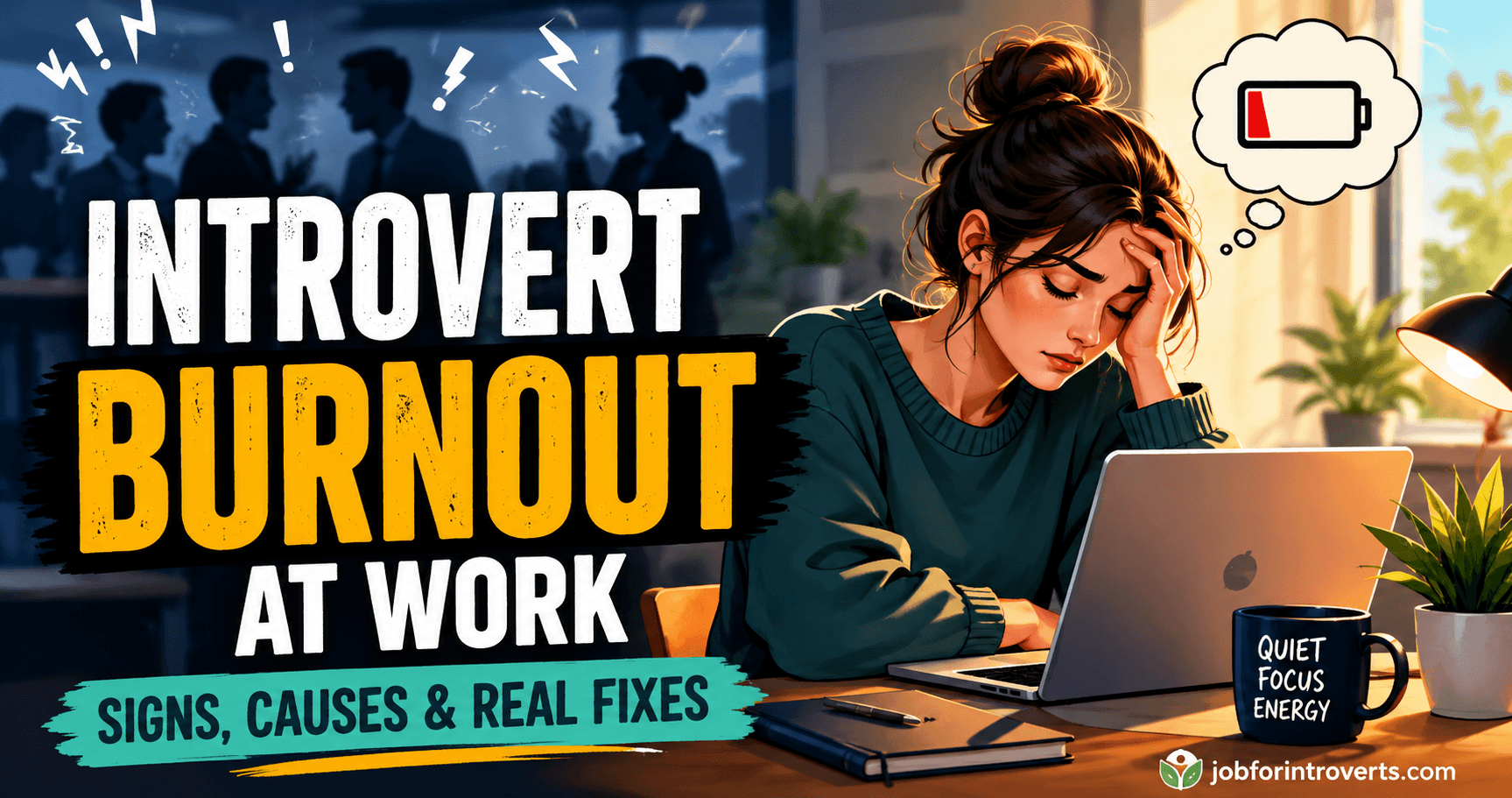
Introvert burnout at work is not just being tired after a long day.
It is the exhaustion that builds when your job constantly demands attention, responsiveness, social energy, and mental availability faster than you can recover it.
If meetings wipe you out, Slack notifications immediately stress you out, and you need complete silence after work just to feel normal again, the problem may not be your work ethic.
It may be the way your work environment interacts with your nervous system every day.
A lot of introverts quietly assume something is wrong with them.
Especially when coworkers seem completely fine with:
- nonstop meetings
- open offices
- constant messaging
- phone calls
- back-to-back conversations
- always being available
So instead of questioning the environment, many introverts start questioning themselves.
- “Why does this drain me so much?”
- “Why does everyone else seem able to handle this?”
- “Am I just too sensitive?”
But many introverts are not failing at work.
They are operating in environments that never allow their brain to fully recover.
Quick Signs You May Be Experiencing Introvert Burnout at Work
You may be dealing with introvert burnout if:
- Meetings leave you mentally exhausted
- You dread hearing notification sounds
- Small talk drains you faster than actual work
- Phone calls instantly break your concentration
- You become quieter as the day goes on
- Open offices make it hard to think clearly
- You feel emotionally numb by the end of the day
- You fantasize about working alone just to focus again
- You need silence after work to recover
- Weekends no longer fully restore your energy
For many introverts, burnout does not look dramatic.
It looks like functioning normally while feeling progressively more depleted underneath.
What Introvert Burnout Actually Feels Like During the Workday
This is the part many articles miss.
Introvert burnout often feels less like “working too hard” and more like being mentally overloaded for too many hours in a row.
It can feel like:
- staring at a Slack message for 20 minutes before answering
- hearing your phone ring and instantly feeling irritated
- zoning out halfway through meetings because your brain feels “full”
- avoiding common areas because you cannot handle another conversation
- pretending to be engaged after your social battery is already gone
- wanting coworkers to stop talking even when they are nice people
- getting home and not wanting anyone to speak to you for an hour
- feeling guilty for being exhausted by people you actually like
Some introverts describe it as:
“Feeling on all day long.”
Others describe it as:
“Feeling emotionally flat.”
Many do not fully realize how burned out they are until they finally get uninterrupted quiet and suddenly feel their body relax.
What Is Introvert Burnout at Work?
Introvert burnout at work is emotional and mental exhaustion caused by prolonged exposure to draining workplace demands.
This can include:
- nonstop meetings
- excessive collaboration
- customer-facing work
- constant interruptions
- open office environments
- emotional masking
- multitasking
- pressure to always be available
Unlike traditional burnout, introvert burnout often feels quieter and harder to recognize.
It can show up as:
- irritability
- social exhaustion
- emotional shutdown
- overstimulation
- withdrawal from coworkers
- difficulty concentrating
- brain fog
- needing isolation to recover
Many introverts continue functioning while internally feeling depleted.
That is part of what makes this difficult to recognize early.
Expert Insight: Why Introverts Burn Out Differently
“Many introverts mistake chronic overstimulation for personal failure. In reality, the nervous system can become overloaded by environments with constant social demand, interruptions, noise, and lack of recovery time. Over time, this can create exhaustion that feels emotional, cognitive, and physical all at once.”
— Licensed Clinical Psychologist
Research around Person-Environment Fit theory also supports the idea that burnout can increase when workplace demands consistently conflict with how someone naturally functions and recovers.
That does not mean introverts cannot succeed in demanding careers.
It means the environment itself matters more than many people realize.
Why Work Feels So Much More Draining for Some Introverts
Some people leave a collaborative brainstorming session energized.
Others leave feeling mentally depleted and needing quiet before they can think clearly again.
Neither reaction is wrong.
But it changes what kind of work environments feel sustainable long term.
Many introverts perform extremely well when they can:
- focus deeply
- think before responding
- work independently
- communicate asynchronously
- avoid constant interruptions
- recover between interactions
That does not mean introverts hate people.
Many introverts enjoy:
- collaboration
- leadership
- teaching
- meaningful conversations
- teamwork in the right conditions
The problem is usually not interaction itself.
It is the nonstop nature of it.
A thoughtful one-on-one conversation may feel energizing.
Eight back-to-back Zoom meetings may feel crushing.
Structured collaboration may feel productive.
Constant availability may feel exhausting.
The Introvert Work Drain Score
One of the biggest mistakes people make is assuming:
“If I’m struggling, I must just be weak.”
But many introverts are simply working in environments that overload them every day.

Rate your current job from 1–5 in each category below:
| Workplace Factor | Low Drain | High Drain |
|---|---|---|
| Meetings | Few and structured | Constant and unpredictable |
| Communication | Mostly async | Always available/live |
| Noise level | Quiet | Loud/open office |
| Interruptions | Protected focus time | Constant task switching |
| Emotional labor | Limited | Customer-facing all day |
| Recovery time | Built-in breaks | Always “on” |
Your Results
- 6–12: Probably manageable for many introverts
- 13–20: Moderate ongoing energy drain
- 21–30: High likelihood of chronic introvert burnout
This is not a diagnosis.
But it may explain why you feel exhausted even when you are technically functioning well.
Not Sure If Your Job Actually Fits Your Personality?
Take the Job Fit Quiz to identify whether your exhaustion is more connected to:
- interaction level
- overstimulation
- communication style
- work environment
- lack of recovery time
- or the role itself
Stop Guessing Which Job Fits You
Take the free 2-minute quiz and get personalized career recommendations.
The Introvert Energy Drain Map
Not all exhaustion comes from the same source.
Some people are socially drained.
Others are overstimulated.
Others feel mentally fragmented from constant interruptions.
Understanding the SOURCE of the drain matters because different problems require different solutions.

1. Social Drain
Caused by:
- meetings
- networking
- customer interaction
- group collaboration
- nonstop messaging
- constant availability
A 30-minute meeting may not look exhausting on paper.
But for some introverts, it requires:
- active listening
- reading social cues
- deciding when to speak
- managing facial expressions
- staying mentally engaged the entire time
- responding quickly under pressure
Then afterward, they are expected to immediately jump back into focused work.
That transition itself becomes draining.
Common feeling:
“I don’t want to talk to anyone after work.”
2. Sensory Drain
Caused by:
- open offices
- movement
- ringing phones
- visual clutter
- noisy environments
- constant background conversation
Many introverts continue processing surrounding stimulation even when trying to ignore it.
Their brain keeps tracking:
- nearby conversations
- footsteps
- people walking behind them
- Slack pings
- random interruptions
This creates constant low-level mental fatigue.
Common feeling:
“My brain feels overloaded.”
3. Focus Drain
Caused by:
- multitasking
- reactive work
- interruptions
- nonstop notifications
- context switching
The issue is not one message.
It is being pulled out of concentration repeatedly until your brain never fully settles into deep focus.
Some introverts spend entire workdays “busy” while feeling like they accomplished almost nothing meaningful because their attention stayed fragmented all day.
Common feeling:
“I can’t think clearly anymore.”
4. Emotional Drain
Caused by:
- masking personality traits
- forced enthusiasm
- difficult customers
- conflict management
- emotional labor
- pretending to be okay when exhausted
Sometimes the draining part is not even the work itself.
It is the performance.
The pressure to constantly appear:
- upbeat
- responsive
- socially engaged
- emotionally available
Even when your battery is completely depleted.
Common feeling:
“I feel emotionally numb.”
Signs Your Work Environment May Be the Real Problem
Sometimes the strongest clue is this:
You function differently outside the environment.
You may notice:
- your anxiety drops during vacations
- you feel calmer working remotely
- your creativity returns in quiet environments
- your exhaustion improves after extended time away from work
- you think more clearly when nobody is interrupting you
Many introverts mistakenly assume:
“If I’m exhausted, I must just be bad at working.”
But good coworkers can still drain you.
Friendly environments can still overwhelm you.
A job can look excellent on paper while quietly exhausting your nervous system every single day.
Normal Work Stress vs Introvert Burnout vs Social Anxiety
| Experience | Normal Work Stress | Introvert Burnout | Social Anxiety |
|---|---|---|---|
| Meetings | tiring | emotionally depleting | fear-inducing |
| Notifications | annoying | mentally overwhelming | may trigger panic |
| Coworker interaction | manageable | draining over time | socially threatening |
| End of workday | needs rest | needs silence/isolation | may replay interactions mentally |
| Focus | interrupted sometimes | constantly fragmented | disrupted by anxiety |
| Recovery | sleep usually helps | weekends barely help | avoidance may increase symptoms |
These experiences can overlap.
But they are not automatically the same thing.
Some introverts experience burnout without social anxiety.
Some extroverts experience burnout too.
And some people simply work in unhealthy environments regardless of personality type.
The 7-Day Introvert Burnout Reset Test
Before assuming you need a completely different career, test whether reducing overstimulation changes your energy.
For one week:
- block 60–90 minutes of uninterrupted focus time daily
- batch Slack and email checks instead of responding instantly
- reduce one unnecessary meeting if possible
- take lunch somewhere quiet
- wear headphones during focus work
- track which interactions drain you most
- pay attention to how you feel after work
At the end of the week, ask yourself:
- Did your energy improve at all?
- Was the biggest issue overstimulation and interruptions?
- Or did the role itself still feel fundamentally draining?
Sometimes the environment is the problem.
Sometimes the role itself is the problem.

Should You Fix the Job or Leave It?
Not every difficult job requires quitting.
But not every draining environment can realistically be fixed either.
Try Adjusting the Environment First If:
- you enjoy the actual work
- your manager is flexible
- remote or hybrid work is possible
- fewer meetings would help
- your energy improves with small changes
- the problem is mainly overstimulation or interruptions
Sometimes relatively small adjustments create significant relief.
For example:
- blocking uninterrupted focus time
- reducing unnecessary meetings
- batching notifications
- shifting to asynchronous updates
- taking recovery breaks between meetings
- avoiding nonstop multitasking
For some introverts, those changes dramatically improve daily energy.
Consider Changing Roles If:
- the core role requires nonstop interaction
- customer-facing work drains you constantly
- you work in a mandatory open office
- your manager expects immediate responses all day
- the role depends heavily on live communication
- weekends no longer restore your energy
- your exhaustion consistently follows you home
- the environment cannot realistically change
Some environments are simply high-drain by design.
For example:
- call-center queue work
- nonstop retail floor interaction
- high-volume customer escalation roles
- highly reactive support environments
- workplaces built around constant interruption
If the WORK interests you but the ENVIRONMENT drains you, try changing the environment first.
If the ROLE itself constantly exhausts you, a better-fit career may help more.
Stop Guessing Which Job Fits You
Take the free 2-minute quiz and get personalized career recommendations.
What Actually Helps Introvert Burnout
Generic self-care advice is usually not enough.
Real improvement often comes from reducing chronic energy drain.
What tends to help most:
- fewer live meetings
- more asynchronous communication
- uninterrupted focus time
- quieter environments
- reduced multitasking
- clearer boundaries around availability
- recovery time between interactions
- limiting after-work social overload
- taking PTO before burnout becomes severe
If symptoms become intense or persistent, professional support may also help.
Especially if burnout starts affecting:
- sleep
- anxiety levels
- physical health
- emotional stability
- daily functioning
Final Thoughts
Many introverts spend years trying to become less exhausted instead of asking whether their environment is sustainable for them in the first place.
That does not mean introverts are weak.
And it does not mean all workplaces are bad.
It means different people function best under different conditions.
Some thrive in constant collaboration.
Others thrive with focus, autonomy, quieter environments, and more recovery time between interactions.
The important thing is recognizing the difference before chronic exhaustion starts feeling like your personality.
Because sometimes the biggest breakthrough is realizing you were never failing at work.
You were trying to function in conditions that constantly depleted you.
Stop Guessing Which Job Fits You
Take the free 2-minute quiz and get personalized career recommendations.

His work has reached millions through platforms like The Good Men Project, Fatherly, and Quora, where he shares practical advice for introverts and people with anxiety.
He writes about jobs for introverts, low-stress careers, and how to build a work life that fits your personality.
- Best Computer Science Careers for Introverts (10 Great Jobs That Fit Your Personality) – July 14, 2026
- Are There Any Work From Home Jobs That Are Not Scams? – July 13, 2026
- Coworkers Don’t Like Me Because I’m Quiet: What to Do – July 10, 2026